Cause for Success: 10 Companies That Put Profit Second and Came in First
Christine Arena
2011
View book
Book guide and evaluation
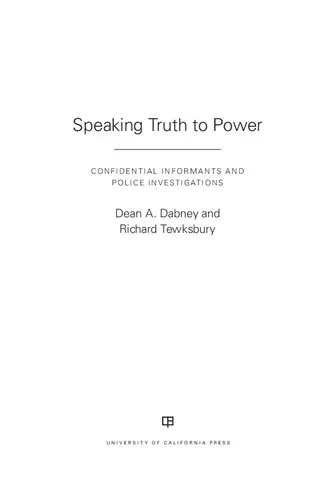
Dean A. Dabney,Richard Tewksbury
0 reviews
Published
pages
views
Introduction to 'Speaking Truth to Power: Confidential Informants and Police Investigations' Policing in modern society is often shrouded in secrecy and complexity, balancing numerous ethical and practical challenges. In this multifaceted landscape, confidential informants
Before you read
Policing in modern society is often shrouded in secrecy and complexity, balancing numerous ethical and practical challenges. In this multifaceted landscape, confidential informants play a critical but often misunderstood role in law enforcement investigations. The book 'Speaking Truth to Power: Confidential Informants and Police Investigations', authored by Dean A. Dabney and Richard Tewksbury, offers an in-depth exploration into this delicate yet highly significant aspect of police work. By peeling back the layers of this controversial investigative tool, the authors provide a well-rounded perspective into the lives of informants, the decisions of police officers, and the broader societal implications of such practices.
This compelling work is a detailed examination of how law enforcement uses, manages, and often grapples with trust and accountability in cases involving confidential informants. Drawing on extensive research, the book delves into themes of ethics, discretion, and policy in law enforcement, while also offering real-world anecdotes that emphasize both the power and pitfalls of working with informants. With its sharp narrative and unprecedented insights, the book seeks to unveil the untold stories lying at the heart of police investigations, challenging readers to confront uncomfortable questions about justice, power, and truth.
'Speaking Truth to Power' examines the delicate and often contentious role of confidential informants (CIs) in modern policing. The authors begin by laying the foundation, exploring the historical use of informants in law enforcement and how their roles have evolved over time. A central focus of the book is on the relationships between CIs and police officers—relationships that are often fraught with mistrust, manipulation, and ethical dilemmas.
Through interviews with law enforcement personnel and informants, the authors highlight the human side of undercover investigations. They explore why individuals agree to become informants, the pressures they face, and how these partnerships affect their lives. The book sheds light on the complex systems of exchange between informants and police officers, where favors, benefits, and trust are currency.
The narrative also dives into the contentious debates surrounding the use of informants. Topics like accountability, misuse of power, exploitation, and the gray areas of legality and morality come under scrutiny. By providing case studies, the authors do not shy away from presenting how law enforcement's reliance on CIs can either lead to groundbreaking investigative breakthroughs or glaring miscarriages of justice.
Lastly, the book doesn’t just critique; it also offers constructive insights into reforming policies, promoting accountability, and fostering ethical practices within police departments. It is a balanced, research-driven exploration designed to provoke thought and incite meaningful change.
"Truth is never simple; it is a patchwork quilt of perspectives, motives, and consequences."
"In the world of informants, loyalty is currency, but trust is a rare commodity."
"Policing is a balancing act of power—a struggle between solving crimes and safeguarding integrity."
The relevance of 'Speaking Truth to Power' extends beyond academic and law enforcement circles. In today’s climate of heightened public scrutiny of law enforcement practices, this book is more vital than ever. By focusing on the largely hidden world of confidential informants, the authors challenge readers to consider the delicate balance between obtaining justice and upholding ethical standards.
This book matters because it tackles a subject often left unexamined, offering readers the opportunity to understand the complexities of policing from a different angle. It empowers law enforcement professionals, policymakers, and the general public to question the status quo and push for greater transparency and fairness in investigative practices. Furthermore, it sheds light on the human cost of law enforcement decisions—both for officers and informants—prompting broader discussions about systemic reforms.
Ultimately, 'Speaking Truth to Power' encourages us to interrogate the relationship between truth, power, and justice, making it a transformative read for anyone invested in the pursuit of fairness and accountability.
Your question is answered in the context of this title and author. Each answer uses 2 points.
0 reviews, 4.5 average out of 5
Sign in to publish a review.
Ask a focused question and learn from the community.
Related references that continue this learning path.
Christine Arena

Henry Richardson,Paul Weithman