

The Child's Discovery of Space: From Hopscotch to Mazes: An Introduction to Intuitive Topology
Jean Sauvy,Simone Sauvy
1974
View book
Book guide and evaluation
Alison Clark;Peter Moss
0 reviews
Published
pages
views
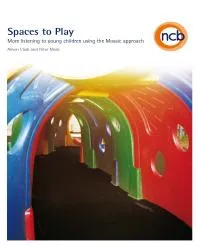
Introduction to "Spaces to Play: More Listening to Young Children Using the Mosaic Approach" "Spaces to Play: More Listening to Young Children Using the Mosaic Approach" is a profound exploration of early childhood environments and the ways in which we can deeply listen
Before you read
"Spaces to Play: More Listening to Young Children Using the Mosaic Approach" is a profound exploration of early childhood environments and the ways in which we can deeply listen to and interpret the perspectives of young children. Written by Alison Clark and Peter Moss, this book builds on the widely acclaimed Mosaic Approach, a participatory framework designed to give children a voice in the spaces they occupy. With an emphasis on collaboration and respect, this book highlights how the perspectives of children can reshape our understanding of early years settings, transforming them into dynamic spaces of learning, engagement, and joy.
The Mosaic Approach, foundational to this work, encourages a shared understanding between educators, researchers, and children. It moves beyond traditional adult-centric approaches and embraces children as active participants in the co-creation of their environments. Through text enriched by real-world examples, theoretical reflections, and actionable methods, "Spaces to Play" offers an invaluable resource for practitioners, parents, and researchers in early childhood education around the world.
The book starts by revisiting the foundations of the Mosaic Approach, a methodology that blends multiple participatory methods like photography, mapping, and interviews to amplify children's voices. It reaffirms the importance of listening—not just hearing the words children say, but truly understanding their perspectives through visual, verbal, and nonverbal cues.
The authors share numerous case studies where children have actively contributed to the design and evaluation of their learning spaces. These examples demonstrate the practical application of the Mosaic Approach in transforming environments into meaningful spaces for both play and education. By integrating children's insights, educators can create spaces that are not only functional but also reflective of children's identities, preferences, and needs.
Additionally, the book dives into the broader significance of participatory practices, explaining how this methodology can influence policy and pedagogy on a larger scale. The overarching message is clear: children’s voices matter, and their perspectives can lead to more inclusive, responsive, and enriching environments.
"Listening is not a one-time act but an ongoing process of interpretation, reflection, and collaboration."
"Children see and sense the world with a freshness and creativity that can inspire those willing to listen."
"By valuing children’s contributions, we not only enrich their environments but also demonstrate that their insights hold power and significance."
"Spaces to Play" is more than a guidebook; it is a call to action for adults—parents, educators, policymakers—to rethink the ways in which we engage with children. At its core, the book positions children not as passive recipients of adult-designed environments, but as active agents capable of co-shaping their own spaces. This shift in perspective is pivotal, particularly in a world where standardized environments often fail to cater to diverse needs and identities.
Moreover, the book provides a practical pathway for achieving this vision, offering methods and strategies that can be implemented in everyday practice. It bridges the gap between research and real-world application, ensuring that its message resonates with a broad range of readers. Whether you are an educator striving to enhance your classroom, a parent curious about incorporating children’s input at home, or a researcher interested in participatory methods, "Spaces to Play" is an essential resource that challenges and inspires.
Ultimately, this book matters because it illuminates the transformative potential of listening—not just as a skill, but as a meaningful act of care and respect for the youngest members of society.
Your question is answered in the context of this title and author. Each answer uses 2 points.
0 reviews, 4.0 average out of 5
Sign in to publish a review.
Ask a focused question and learn from the community.
Related references that continue this learning path.
Jean Sauvy,Simone Sauvy
Adele Faber,Elaine Mazlish