Book guide and evaluation
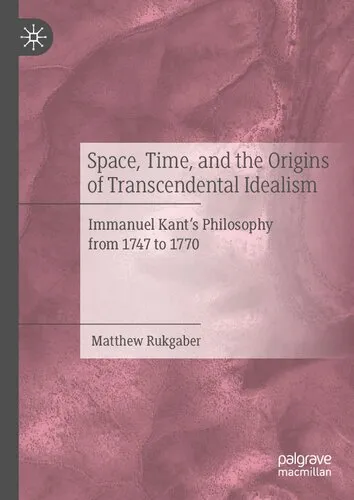
Space, Time, and the Origins of Transcendental Idealism: Immanuel Kant’s Philosophy from 1747 to 1770
Matthew Rukgaber
English
Beginner
Relativity
4.7 / 5
0 reviews
2020
Published
290
pages
711
views
Introduction to 'Space, Time, and the Origins of Transcendental Idealism: Immanuel Kant’s Philosophy from 1747 to 1770' This book offers a comprehensive exploration of Immanuel Kant's philosophical development leading to his groundbreaking theory of transcendental ideali
Before you read
What will you get from this book?
Introduction to 'Space, Time, and the Origins of Transcendental Idealism: Immanuel Kant’s Philosophy from 1747 to 1770'
This book offers a comprehensive exploration of Immanuel Kant's philosophical development leading to his groundbreaking theory of transcendental idealism. Spanning the critical years from 1747 to 1770, it charts the evolution of Kant's thoughts on space and time, unraveling the intellectual journey that defined his philosophical legacy.
Detailed Summary of the Book
The monograph delves into the key philosophical phases of Kant's early career, marking the transition from his pre-critical works to his critical philosophy, culminating in the 'Critique of Pure Reason.' It starts with Kant's engagement with the Newtonian scientific paradigm, examining how this influenced his earliest thoughts on metaphysics and natural philosophy. As Kant grappled with Newton's concepts, he began to question the nature of space and time themselves, setting the stage for his revolutionary ideas.
By tracing these intellectual currents, the book elucidates how Kant moved away from the empirical realism of his predecessors towards the transcendental idealism for which he became famous. Central to this development is Kant's realization that space and time are not external entities but forms of intuition intrinsic to the human mind. This insight leads to the discernment that knowledge is a synthesis of sensory data shaped by these a priori intuitions.
The analysis further highlights the conversations and correspondences with contemporary philosophers and scientists that shaped Kant's thinking, offering a window into the vibrant intellectual milieu of 18th-century Europe. By the end of this transformative period, Kant arrives at the profound conclusion that our experience of the world is mediated by the structures of our own consciousness, a principle that would redefine modern philosophy.
Key Takeaways
- Kant's examination of space and time as forms of human intuition rather than empirical realities.
- The progression from Kant's engagement with Newtonian science to his development of transcendental idealism.
- Insight into the intellectual exchanges that influenced Kant's philosophical evolution.
- The conceptual groundwork laid during these years for Kant's critical philosophy and its effects on later philosophical thought.
Famous Quotes from the Book
"The essence of Kant’s vision lay not in the rejection of reality but in the profound understanding that reality is as much a construction of the mind as it is a perception of the external world."
"In these formative years, Kant dissected space and time not as distant dimensions but as the closest bounds of human cognition."
Why This Book Matters
This book is pivotal for anyone interested in understanding the underpinnings of modern philosophical thought. It addresses the crucial developmental phase of one of philosophy's greatest figures, Immanuel Kant, uncovering the seeds of ideas that would bloom into his mature work with the 'Critique of Pure Reason.' Readers gain not only a deeper comprehension of Kant's philosophical journey but also an appreciation for the historical context and scholarly dialogues that influenced him.
Kant's paradigm shift from empirical realism to transcendental idealism marks a fundamental turn in philosophical inquiries about the nature of reality, epistemology, and metaphysics. By focusing on the conception of knowledge as constructed through mental faculties rather than passively received from the world, Kant initiated a discourse that resonates in contemporary debates across philosophy and cognitive science.
Ask this book
Your question is answered in the context of this title and author. Each answer uses 2 points.
Sign in to ask the book assistant.
Reader reviews
0 reviews, 4.7 average out of 5
No reviews yet
If you have read this book, help the next reader with your experience.
Write a review
Sign in to publish a review.
Reader questions and answers
Ask a focused question and learn from the community.
Sign in to ask or answer a question.
No questions yet
Be the first to ask a clear, useful question.
What to read next
Related references that continue this learning path.
![Cover of Relativity Visualized [elem txt]](https://s3.refhub.ir/images/thumb/Relativity_Visualized__elem_txt_16493.webp)