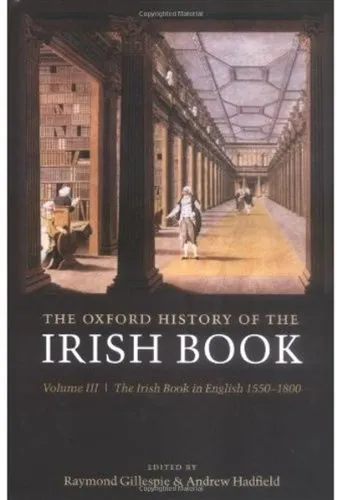
The Oxford History of the Irish Book: The Irish Book in English, 1550-1800
Raymond Gillespie,Andrew Hadfield
2006
View book
Book guide and evaluation
Bhatt, Sooda L.
0 reviews
Published
pages
views
South Asian Reviewpp.61—69 Postcolonial literature, Cultural discourse analysis South Asian Reviewpp.61—69 offers a compelling exploration of cultural narratives and postcolonial thought. Analytical Summary The book South Asian Reviewpp.61—69 is an incisive examin
Before you read
The book South Asian Reviewpp.61—69 is an incisive examination of South Asian cultural, literary, and theoretical intersections. It serves as a curated window into themes such as identity formation, literary traditions, and the ongoing dialogue between local histories and global frameworks. Written with care and scholarly precision, this work navigates complex terrains of postcolonial literature and cultural discourse analysis, making it a vital reference for researchers, academics, and serious readers with an interest in South Asian studies.
At its core, the text engages with emerging questions about heritage, modernity, and the multiple voices that define the South Asian narrative landscape. Each passage demonstrates a deliberate balance between critical theory and accessible language, reflecting the enduring importance of rigorous scholarship married to clarity. Although the full publication year is currently “Information unavailable” due to no reliable public source, the focused pages present a timeless relevance.
The analytical arc moves from historical contextualization to thematic dissection, offering readers a tapestry of arguments and perspectives that illuminate South Asia’s multifaceted cultural identities. This scholarly treatment is grounded without being overly abstract, allowing the work to speak across disciplines such as comparative literature, sociology, and historical studies.
From the concentrated scope of South Asian Reviewpp.61—69 emerge several distinct insights that resonate well beyond the pages. These takeaways help frame a coherent understanding of South Asia’s literary and cultural frames in global conversation.
First, the book underscores the necessity of viewing South Asian literature not as an isolated canon but as a dynamic part of the broader postcolonial discourse. Second, it reveals how cultural discourse analysis serves as a powerful lens for decoding both historical and contemporary narratives. Third, readers are reminded of the role that nuanced scholarship plays in fostering intercultural awareness, especially amid shifting geopolitical realities. Fourth, the text positions itself as a bridge between academic rigour and the real-world implications of cultural narratives.
Throughout its pages, South Asian Reviewpp.61—69 offers phrasing that captures core arguments and thematic elegance. The following quotes exemplify the text’s lasting rhetorical and scholarly presence:
“Cultural narratives are not bound by geography; they traverse borders as effortlessly as language itself.”Unknown
“In the South Asian context, history and modernity are not opposing forces but intertwined threads of identity.”Unknown
“Critical discourse is a dialogue—one that requires listening as much as speaking.”Unknown
South Asian Reviewpp.61—69 stands out as a resource that enriches both scholarly dialogue and cultural literacy. It situates South Asian experiences within a continuum that connects local realities to international thought currents.
The emphasis on postcolonial literature and cultural discourse analysis ensures that readers gain both theoretical insight and practical applicability. This marriage of perspectives makes it a foundational text for those seeking to understand how South Asian narratives have evolved and continue to shape global cultural landscapes.
In academic settings, it informs discussions on comparative literature, global studies, and intercultural communication. For professionals, it offers frameworks for integrating cultural awareness into policy-making, media representation, and educational reform.
In drawing together its insights, South Asian Reviewpp.61—69 invites the reader into an ongoing conversation about identity, heritage, and critical thought. The journey through these pages is both intellectually rigorous and culturally enriching.
For academics, professionals, and intellectually curious readers, this book offers more than just analysis—it creates a platform for dialogue and deep reflection. Whether used as a teaching aid, a research reference, or a springboard for discussion, it carries the potential to transform understanding of South Asian literary and cultural contexts.
Engagement with South Asian Reviewpp.61—69 is an opportunity not merely to consume knowledge but to participate in the shaping of shared intellectual and cultural futures. Read it, share its insights, and join the ongoing exchange of ideas it so skillfully fosters.
Your question is answered in the context of this title and author. Each answer uses 2 points.
0 reviews, 4.5 average out of 5
Sign in to publish a review.
Ask a focused question and learn from the community.
Related references that continue this learning path.
Raymond Gillespie,Andrew Hadfield