
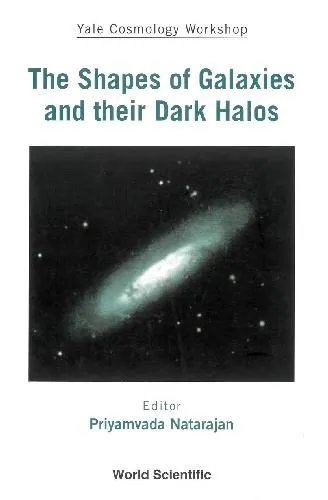
Shapes of Galaxies and Their Dark Halos: The Proceedings of the Yale Cosmology Workshop
Natarajan P. (Ed)
2002
View book
Book guide and evaluation
Howard Baer (auth.),David Cline (eds.)
0 reviews
Published
pages
views
Introduction to the Book "Sources and Detection of Dark Matter and Dark Energy in the Universe" offers a comprehensive exploration of one of the most compelling fields in cosmology. This book is a collection of proceedings from the 10th UCLA Symposium held in Febru
Before you read
"Sources and Detection of Dark Matter and Dark Energy in the Universe" offers a comprehensive exploration of one of the most compelling fields in cosmology. This book is a collection of proceedings from the 10th UCLA Symposium held in February 2012, gathering some of the most profound minds in physics to discuss the enigmatic components constituting a significant part of our universe: dark matter and dark energy. Their exact nature eludes scientific understanding, yet their gravitational effects on cosmic structures are undeniable. This meeting of experts provides an invaluable insight into our ongoing quest to comprehend these dark sectors of the cosmos.
The book captures the discussions and research presentations from the UCLA Symposium, focusing on both theoretical developments and experimental advances. It details the progress in detecting dark matter particles, relying on direct detection experiments, indirect detection via gamma rays, and observation through neutrinos. Theoretical physicists expound on supersymmetric particles as plausible dark matter candidates, while advancements in astronomical observations refuel hypotheses on the dark matter composition.
The second part of the book shifts to dark energy, aiming to elucidate this mysterious force driving the accelerated expansion of the universe. Contributions from prominent researchers present current models of dark energy, including the cosmological constant and alternative theories such as quintessence fields. Observational efforts from supernovae surveys, the Cosmic Microwave Background, and gravitational lensing are discussed as key methods in refining our understanding of dark energy's role on a cosmological scale.
"The search for dark matter is not just a pursuit of the unknown; it is a journey into the future of physics."
"Dark energy is a concept as elusive as it is central to our understanding of the cosmos; it stands as the ultimate protagonist in the narrative of the universe's expansion."
The significance of this book lies in its timely encapsulation of the ongoing scientific dialogue around dark matter and dark energy. As our universe seems predominantly governed by these unseen forces, the insights gathered here are indispensable for scholars, researchers, and anyone keen on the frontiers of cosmology. The symposium proceedings present a unique opportunity to witness the converging streams of theoretical speculation and empirical evidence, pushing the boundaries of what we know about the universe.
Furthermore, this compilation serves as a historical documentation of the diverse approaches and the relentless pursuit of knowledge, inspiring future explorations. The relevance of this work extends beyond academic curiosity, as understanding these cosmic forces could one day influence technological innovation and inform our perspective on humanity's place in the universe.
Your question is answered in the context of this title and author. Each answer uses 2 points.
0 reviews, 4.3 average out of 5
Sign in to publish a review.
Ask a focused question and learn from the community.
Related references that continue this learning path.
Natarajan P. (Ed)
Minos Axenides,George Fanourakis,John Vergados

Joel R. Primack (auth.),David B. Cline (eds.)