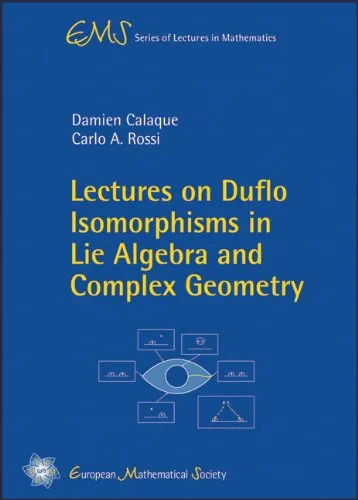
Lectures on Duflo Isomorphisms in Lie Algebra and Complex Geometry (EMS Series of Lectures in Mathematics)
Damien Calaque,Carlo A. Rossi
2011
View book
Book guide and evaluation
John P. Boyd
0 reviews
Published
pages
views
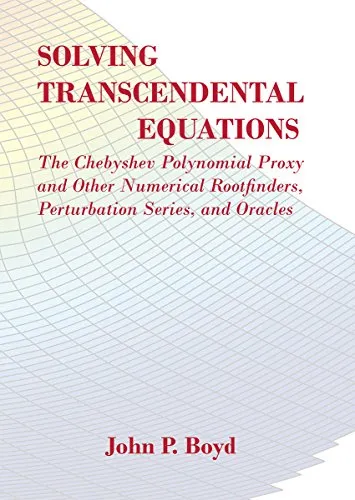
Introduction to Solving Transcendental Equations: The Chebyshev Polynomial Proxy and Other Numerical Rootfinders, Perturbation Series, and Oracles Welcome to an exploration into the intricate world of transcendental equations—a domain where mathematics meets advanced compu
Before you read
Welcome to an exploration into the intricate world of transcendental equations—a domain where mathematics meets advanced computation. This book delves into the sophisticated methods of solving transcendental equations, primarily focusing on the utilization of the Chebyshev Polynomial Proxy. With a blend of numerical methods, perturbation series, and oracles, it offers a comprehensive guide for both novices and experienced mathematicians trying to demystify complex equations that transcend algebraic limitations.
In "Solving Transcendental Equations," we embark on a journey beginning with an introduction to transcendental equations and their significance across various scientific disciplines. The book opens with a discussion on the fundamental nature of transcendental equations, differentiating them from their algebraic counterparts, and highlighting their appearance in fields such as physics and engineering.
The core of the text elaborates on the Chebyshev Polynomial Proxy, a pivotal method that simplifies the approximation of transcendental equations. This technique leverages Chebyshev polynomials' remarkable properties to efficiently approximate functions that transcend simple algebraic representation.
Following this, the book expands into a discussion on various numerical root-finding methods, including Newton's method, the bisection method, and their sophisticated variants. Each technique is elucidated with examples and graphical illustrations, making complex concepts more accessible.
The narrative then segues into the role of perturbation series, explaining how minor changes in parameters can lead to significant insights into the nature of solutions. This section is integral for researchers dealing with problems where exact solutions are elusive.
Lastly, the book ventures into the concept of oracles—an innovative perspective for guiding numerical methods to likely regions where roots can be found. By combining these methodologies, readers are equipped with a toolkit for tackling some of the most challenging mathematical problems encountered in applied mathematics and engineering.
"The essence of solving transcendental equations lies in embracing the complexity, not in fearing it."
"Mathematics is not about numbers alone; it's an art of finding solutions in the boundless space that exists beyond the algebraic realm."
This book is not just a collection of mathematical methods—it is a bridge connecting traditional mathematical theories with modern computational practices. By synthesizing various approaches into a comprehensive methodology for solving transcendental equations, it serves as an essential resource for mathematicians, engineers, and scientists.
"Solving Transcendental Equations" empowers readers by equipping them with the tools and knowledge necessary to tackle equations that are pivotal in technological and scientific advancement. Through illustrative examples and meticulous explanations, the book elevates the reader's problem-solving capabilities, making it a significant contribution to the field of applied mathematics.
Your question is answered in the context of this title and author. Each answer uses 2 points.
0 reviews, 4.0 average out of 5
Sign in to publish a review.
Ask a focused question and learn from the community.
Related references that continue this learning path.
Damien Calaque,Carlo A. Rossi