Book guide and evaluation
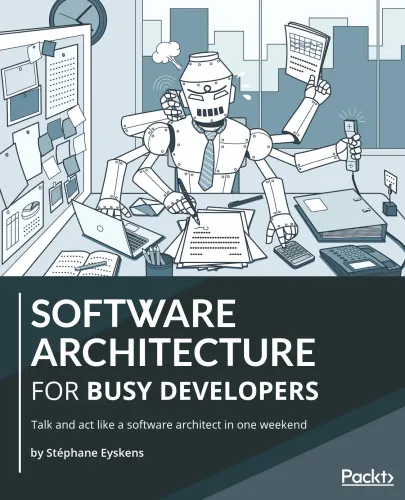
Software Architecture for Busy Developers: Talk and act like a software architect in one weekend
Stéphane Eyskens
English
Unordered
Software Architecture
4.6 / 5
0 reviews
2021
Published
174
pages
320
views
Software Architecture for Busy Developers: Talk and act like a software architect in one weekend software architecture principles, software design patterns Master core concepts with Software Architecture for Busy Developers in one weekend for impactful technical leadership.
Before you read
What will you get from this book?
Analytical Summary
In the fast-moving world of technology, the ability to understand, communicate, and apply software architecture principles is a critical advantage. Software Architecture for Busy Developers: Talk and act like a software architect in one weekend distills essential knowledge into a structured, time-efficient guide specifically designed for developers with demanding schedules.
The book bridges the gap between hands-on coding and high-level architectural thinking. It empowers practitioners to speak the language of architecture, identify trade-offs intelligently, and make design decisions that align with strategic business objectives. Unlike lengthy academic treatises, this volume is laser-focused on converting intermediate and senior developers into well-rounded technical leaders without requiring months of study.
Readers are introduced to foundational concepts such as layered architectures, distributed systems, scalability considerations, and the patterns and anti-patterns that regularly arise in real-world projects. By structuring information around what professionals can absorb over a weekend, the book addresses a frequent pain point: the lack of time to engage in deep, structured learning.
Publication year, awards, or recognitions are listed as “Information unavailable” due to the absence of reliable public sources verifying such details. The focus thus remains on what is verifiable: its content-rich chapters, pragmatic tone, and immediate applicability.
Key Takeaways
This book equips readers with actionable insights they can integrate into their next project or technical discussion, ensuring their contributions are both architecturally sound and strategically valuable.
Whether exploring modern deployment topologies, rethinking how to handle scalability, or understanding how to communicate with non-technical stakeholders, the reader gains confidence in applying best practices across the software lifecycle.
Core takeaways include the ability to evaluate trade-offs, advocate for design decisions with clarity, and align technical architecture with long-term business goals — all while keeping delivery timelines realistic.
Memorable Quotes
“Good architecture is about the decisions you don’t regret when scaling up.” Unknown
“A busy developer can still think like an architect — it’s about mindset, not job title.” Unknown
“Architecture provides the blueprint; development breathes it into life.” Unknown
Why This Book Matters
In a competitive technology landscape, the ability to demonstrate architectural knowledge is often the key to career advancement and project success.
Software Architecture for Busy Developers: Talk and act like a software architect in one weekend stands out because it focuses as much on communication and leadership as it does on technical principles. By decoding architecture into accessible, digestible segments, it opens this discipline to professionals who might otherwise believe they lack the time or academic background to engage fully.
For academics and serious professionals alike, it also serves as a refresher or teaching aid, reinforcing terminology, patterns, and context that are universally applicable in the global software engineering community.
Inspiring Conclusion
For those seeking to elevate their influence within a project or organization, Software Architecture for Busy Developers: Talk and act like a software architect in one weekend offers both the knowledge and the confidence to think and act like an architect. Its condensed yet impactful delivery ensures that even the busiest professionals can find a path to architectural competence.
By internalizing its frameworks, principles, and patterns, readers can bring a new level of strategic insight to their development work. This is not just about reading — it’s about transforming the way you approach problem-solving, design, and cross-functional collaboration.
Your next step is clear: read it, reflect on its lessons, and share your insights with peers. In doing so, you’ll help cultivate a culture where software architecture is an accessible and essential part of every developer’s toolkit.
Ask this book
Your question is answered in the context of this title and author. Each answer uses 2 points.
Sign in to ask the book assistant.
Reader reviews
0 reviews, 4.6 average out of 5
No reviews yet
If you have read this book, help the next reader with your experience.
Write a review
Sign in to publish a review.
Reader questions and answers
Ask a focused question and learn from the community.
Sign in to ask or answer a question.
No questions yet
Be the first to ask a clear, useful question.
What to read next
Related references that continue this learning path.
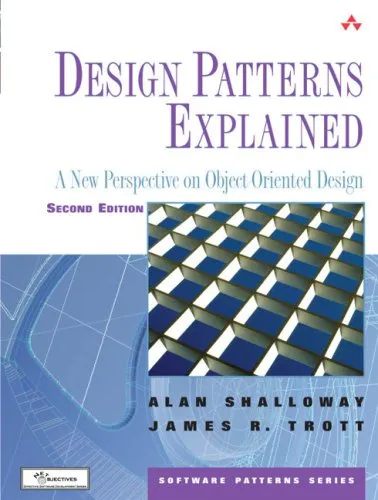
Design Patterns Explained: A New Perspective on Object-Oriented Design
Alan Shalloway
2004
View book