The Righteous Mind: Why Good People Are Divided by Politics and Religion
Jonathan Haidt
2012
View book
Book guide and evaluation
Beattie,Peter
0 reviews
Published
pages
views
Introduction **Social Evolution, Political Psychology, and the Media in Democracy: The Invisible Hand in the U.S. Marketplace of Ideas** explores the intersection of social evolution, human psychology, media dynamics, and democratic governance. This book provides readers w
Before you read
**Social Evolution, Political Psychology, and the Media in Democracy: The Invisible Hand in the U.S. Marketplace of Ideas** explores the intersection of social evolution, human psychology, media dynamics, and democratic governance. This book provides readers with an in-depth examination of how ideas propagate within a democratic society, how media systems influence the public's thoughts and behavior, and how these dynamics are shaped by our evolutionary past. Using a multidisciplinary approach, it unveils the often unseen forces that shape public opinion, policy preferences, and collective decision-making in the United States.
Democracy thrives on the free exchange of ideas, but this marketplace of ideas does not operate as freely or rationally as often idealized. Media ecosystems, driven by profit motives, political agendas, and cognitive biases, play a pivotal role in shaping the contours of democratic discourse. The book dissects the "invisible hand" that directs this marketplace, revealing how misinformation, partisanship, and psychological tendencies can distort democratic deliberation and decision-making. By connecting principles of evolutionary psychology with modern communication research, it illuminates the deeper mechanisms behind political polarization, misinformation, and other critical challenges facing democracy today.
This book is divided into several thought-provoking chapters that span the disciplines of sociology, evolutionary theory, political psychology, and media studies. Its key goal is to unravel the hidden dynamics that influence how individuals and societies process information, form opinions, and enact policies.
Starting with an exploration of evolutionary principles, the book delves into how human cognition has been shaped over thousands of years to prioritize specific patterns of thinking. Topics include tribalism, confirmation bias, and emotional reasoning—psychological tendencies that can undermine rational thinking in a modern democratic context. Through engaging examples and academic insights, the book connects these evolutionary traits to contemporary political behavior, explaining why humans are predisposed to groupthink, fear of outsiders, or susceptibility to echo chambers.
From there, the focus shifts to the role of media in the "marketplace of ideas." By analyzing the U.S. media landscape, the book discusses how a competitive, profit-driven media system reinforces polarization and amplifies sensationalism. The intricacies of agenda-setting, framing, and media bias are dissected, revealing how these factors can distort our understanding of reality and undermine meaningful discourse.
Finally, the book addresses solutions, offering strategies to counteract the negative effects of media manipulation, societal polarization, and misinformation. Drawing on research from cognitive science, education, and grassroots activism, it emphasizes the urgent need for systemic reforms and public awareness initiatives to safeguard the future of democracy.
This book features several notable insights that capture the essence of its arguments:
"The marketplace of ideas functions less like a rational exchange and more like a Darwinian jungle, where the survival of the loudest often outweighs the survival of the truest."
"Democracy's greatest paradox is that a system built on collective reasoning can so easily be undone by individual emotionalism."
In an era defined by misinformation, partisan divides, and declining trust in democratic institutions, this book is a timely intervention. It equips readers with the tools to recognize and combat the psychological and systemic forces undermining democratic discourse. By blending academic rigor with accessible language, it appeals to scholars, policymakers, journalists, and concerned citizens alike.
The U.S. and other democracies across the globe face mounting challenges, ranging from the pervasive influence of social media algorithms to the erosion of public trust in traditional institutions. This book underscores the urgency of reimagining our information ecosystem and fostering media literacy to ensure a healthier marketplace of ideas. Ultimately, it serves as both a call to action and a guide for understanding the underlying dynamics that drive our political and media environments.
Your question is answered in the context of this title and author. Each answer uses 2 points.
0 reviews, 4.0 average out of 5
Sign in to publish a review.
Ask a focused question and learn from the community.
Related references that continue this learning path.
Jonathan Haidt
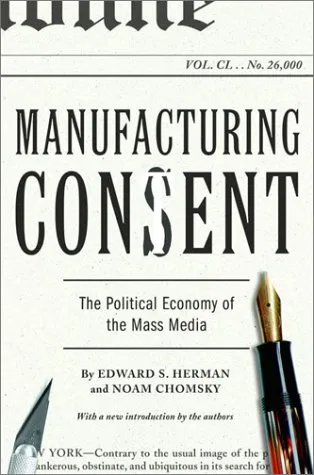
Edward S. Herman,Noam Chomsky