
Book guide and evaluation
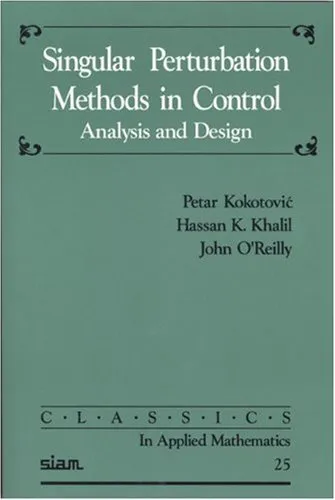
Singular Perturbation Methods in Control: Analysis and Design
Petar Kokotovic,Hassan K. Khalil,John O'Reilly
English
Beginner
Mathematics
4.4 / 5
0 reviews
1987
Published
388
pages
174
views
Introduction to Singular Perturbation Methods in Control: Analysis and Design Singular Perturbation Methods in Control: Analysis and Design is a comprehensive exploration of the theory and applications of singular perturbation methods in control systems. Authored by Petar
Before you read
What will you get from this book?
Introduction to Singular Perturbation Methods in Control: Analysis and Design
Singular Perturbation Methods in Control: Analysis and Design is a comprehensive exploration of the theory and applications of singular perturbation methods in control systems. Authored by Petar Kokotovic, Hassan K. Khalil, and John O'Reilly, the book delves deep into this mathematical approach, which is pivotal for designing, analyzing, and optimizing systems operating across multiple timescales. First published as a much-needed resource for researchers, engineers, and students, this text has become a cornerstone in the control systems engineering domain, offering clarity, precision, and practical insights into the field.
Singular perturbation techniques are especially effective for control systems characterized by the coexistence of fast and slow dynamics. These systems appear commonly in engineering, biological, and physical contexts, presenting unique challenges in analysis and design. This book uniquely addresses those challenges, making the concepts accessible without sacrificing mathematical rigor. It is particularly valuable for those seeking a strong theoretical foundation while emphasizing practical design methodologies.
Detailed Summary of the Book
At its core, the book provides a thorough exposition of the mathematical and practical insights behind singular perturbation techniques. It starts by introducing the fundamental concepts of singular perturbations and their role in control design. The interplay between fast and slow subsystems is intricately examined, offering readers an understanding of how different timescales influence system behavior.
The authors methodically navigate through key topics, including model reduction, stability analysis, composite control design, and optimization techniques. Each chapter is carefully structured, combining theoretical analysis with illustrative examples to help bridge the gap between abstract mathematics and engineering practice.
Real-world applications are prominently featured, showcasing the relevance of singular perturbation methods. Readers are guided through problems in robotics, aerospace engineering, power systems, and more, where the techniques discussed are used to create effective and robust control solutions. Additionally, problems and exercises at the end of each chapter encourage the reader to apply key concepts, bolstering understanding and encouraging independent exploration.
Key Takeaways
- A clear understanding of singular perturbation methods and their role in handling multi-timescale systems.
- Practical guidelines for applying these methods to real-world control design and analysis challenges.
- A structured approach to reducing system complexity through model reduction and hierarchical control design.
- Insights into stability analysis for multi-timescale systems and how to ensure robust performance.
- Exposure to various advanced applications in engineering fields such as robotics, power systems, and aerospace engineering.
Famous Quotes from the Book
"The essence of singular perturbation analysis lies in its ability to decouple fast and slow dynamics, allowing for a layered understanding of complex systems."
"Control design is both an art and a science; singular perturbation techniques bridge the two by simplifying the complex while preserving the important."
"The interplay between theory and application is what drives the utility of singular perturbation methods in practical engineering problems."
Why This Book Matters
Singular Perturbation Methods in Control: Analysis and Design is more than just a textbook; it is a vital tool for anyone serious about mastering modern control systems design. The field of control systems is evolving rapidly, with increasing demands for robust and efficient solutions. Multi-timescale problems are common, and failure to address these issues effectively can lead to suboptimal performance or even system instability.
What sets this book apart is its careful balance between theory and application. By delving into the mathematical underpinnings of singular perturbation methods while offering pragmatic design approaches, the book appeals to both researchers and practitioners. It empowers readers with the knowledge needed to tackle complex real-world problems confidently, ensuring that their solutions are not only mathematically sound but also operationally effective.
This text is essential for graduate students, researchers, and professionals in the fields of control engineering, applied mathematics, and system dynamics. Its lasting relevance underscores its importance, making it a must-read for anyone interested in this fascinating and critical domain.
Ask this book
Your question is answered in the context of this title and author. Each answer uses 2 points.
Sign in to ask the book assistant.
Reader reviews
0 reviews, 4.4 average out of 5
No reviews yet
If you have read this book, help the next reader with your experience.
Write a review
Sign in to publish a review.
Reader questions and answers
Ask a focused question and learn from the community.
Sign in to ask or answer a question.
No questions yet
Be the first to ask a clear, useful question.
What to read next
Related references that continue this learning path.


Modern Computer Vision with PyTorch: A Practical Roadmap From Deep Learning Fundamentals to Advanced Applications and Generative AI, 2nd Edition
V Kishore Ayyadevara,Yeshwanth Reddy
2023
View book