

Book guide and evaluation
Several Complex Variables I: Introduction to Complex Analysis
A. G. Vitushkin
English
Beginner
Art
4.5 / 5
0 reviews
1990
Published
126
pages
184
views
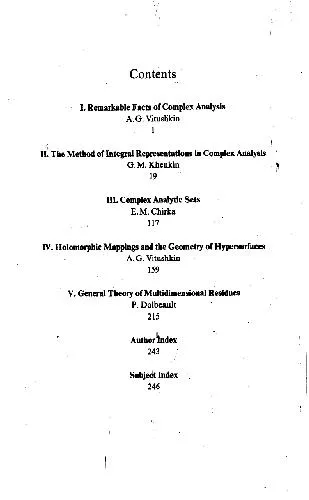
Introduction to "Several Complex Variables I: Introduction to Complex Analysis" Authored by A. G. Vitushkin, "Several Complex Variables I: Introduction to Complex Analysis" presents readers with a masterful exploration of the rich and intricate world of several complex variabl
Before you read
What will you get from this book?
Introduction to "Several Complex Variables I: Introduction to Complex Analysis"
Authored by A. G. Vitushkin, "Several Complex Variables I: Introduction to Complex Analysis" presents readers with a masterful exploration of the rich and intricate world of several complex variables. Written for advanced mathematics students and researchers, this book meticulously maps out the foundational principles, historical evolution, and cutting-edge research within the field. It serves as a key resource for anyone interested in understanding the profound connection between calculus, algebra, and geometry in multiple complex dimensions.
Detailed Summary of the Book
In "Several Complex Variables I," the subject of function theory for several complex variables is examined with remarkable clarity. Beyond its roots in classical complex analysis, this domain involves studying higher-dimensional spaces where complex variables interact in fascinating and often counterintuitive ways. This book begins with an accessible introduction to the basic principles of complex analysis, gradually progressing into critical questions such as multidimensional holomorphy, domains of holomorphy, and the problem of analytic continuation.
Vitushkin emphasizes a balanced approach by intertwining theoretical concepts with concrete examples, allowing readers to grasp challenging ideas such as the multidimensional generalization of the Cauchy Integral Theorem, the Hartogs phenomenon, and the Levi Problem. Topics like pseudoconvexity, the role of plurisubharmonic functions, and integral representations are thoroughly examined, providing a solid mathematical framework for future study and research.
The author also delves into the historical underpinnings of the discipline, highlighting the contributions of prominent mathematicians who have shaped the field, including K. Weierstrass, H. Cartan, and L. Hörmander. This historical context not only enriches the reader’s understanding of the subject but also situates it within the broader evolution of mathematics.
As the first installment in a multi-part series, the book lays a strong foundation while also pointing forward to advanced topics, ensuring it is suitable for both specialists and newcomers alike.
Key Takeaways
- Comprehensive introduction to several complex variables and their applications in mathematics.
- Exploration of foundational concepts such as holomorphic functions, domains of holomorphy, and pseudoconvexity.
- Detailed investigation of key results including the Hartogs Extension Theorem and the Levi Problem.
- A balance of historical insights and modern developments in analysis.
- A stepping stone for advanced research in complex geometry, mathematical physics, and other fields reliant on multivariable complex analysis.
Famous Quotes from the Book
"The study of several complex variables represents not just an extension of classical analysis, but a profound shift in perspective – one that challenges us to reimagine the interaction of geometric, analytic, and topological principles."
"Multidimensional holomorphy is an artful balance of simplicity and complexity, where the intuitive and the abstract meet to produce unexpected results."
"History has shown us that the genius of mathematics lies not only in solving equations but also in uncovering the unifying structures that bind seemingly disparate fields."
Why This Book Matters
The field of several complex variables is central to many modern advancements in pure and applied mathematics, and this book provides a gateway to its mastery. Vitushkin’s work is not just a textbook but an intellectual journey into the inner workings of an elegant and challenging mathematical universe. By presenting key concepts in a logical and structured manner, the text empowers readers to tackle both theoretical and applied problems with confidence.
As mathematics continues to evolve alongside the demands of science and technology, an understanding of multidimensional analytic methods becomes essential. Engineers, physicists, and computer scientists increasingly rely on ideas from complex analysis to model phenomena in areas as diverse as quantum mechanics and machine learning. Thus, "Several Complex Variables I" bridges gaps between disciplines, preparing readers to approach problems with rigor and creativity.
Furthermore, this book contributes to preserving the rich intellectual legacy of the subject while ensuring its continued growth and relevance. It is a testament to the enduring power of human curiosity and the pursuit of knowledge.
Ask this book
Your question is answered in the context of this title and author. Each answer uses 2 points.
Sign in to ask the book assistant.
Reader reviews
0 reviews, 4.5 average out of 5
No reviews yet
If you have read this book, help the next reader with your experience.
Write a review
Sign in to publish a review.
Reader questions and answers
Ask a focused question and learn from the community.
Sign in to ask or answer a question.
No questions yet
Be the first to ask a clear, useful question.
What to read next
Related references that continue this learning path.


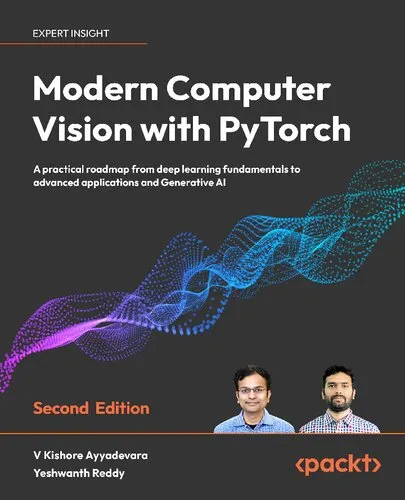
Modern Computer Vision with PyTorch: A Practical Roadmap From Deep Learning Fundamentals to Advanced Applications and Generative AI, 2nd Edition
V Kishore Ayyadevara,Yeshwanth Reddy
2023
View book