
Book guide and evaluation
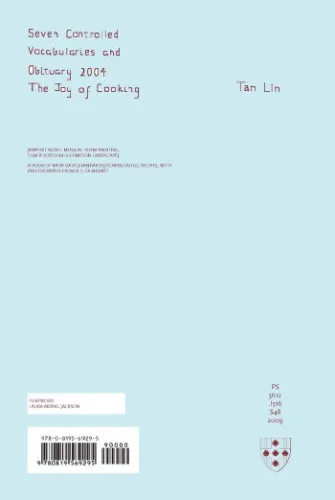
Seven controlled vocabularies and obituary 2004, the joy of cooking: airport novel musical poem painting film photo landscape
Lin,Tan
English
Beginner
Topology
4.2 / 5
0 reviews
2010
Published
223
pages
160
views
Introduction to "Seven Controlled Vocabularies and Obituary 2004, The Joy of Cooking: Airport Novel Musical Poem Painting Film Photo Landscape" Welcome to a world where boundaries blur, genres converge, and traditional categorizations dissolve into a fluid mosaic of artist
Before you read
What will you get from this book?
Introduction to "Seven Controlled Vocabularies and Obituary 2004, The Joy of Cooking: Airport Novel Musical Poem Painting Film Photo Landscape"
Welcome to a world where boundaries blur, genres converge, and traditional categorizations dissolve into a fluid mosaic of artistic exploration. "Seven Controlled Vocabularies and Obituary 2004, The Joy of Cooking: Airport Novel Musical Poem Painting Film Photo Landscape" by Lin Tan is a work that defies convention and invites readers to rethink the frameworks through which art and narrative are consumed. By navigating the intersections of multiple disciplines and mediums, this book challenges hierarchies of meaning and proposes new ways of understanding creativity and culture.
Detailed Summary of the Book
Lin Tan's "Seven Controlled Vocabularies" is a genre-defying experiment in literary form and thematic inquiry. At its heart, the book is an amalgamation of what appear to be unrelated fragments: an obituary from 2004, reflections on culinary arts, and explorations of forms ranging from airport novels to musical compositions, poems, artworks, films, photographs, and landscapes. What ties these elements together is the interplay of "controlled vocabularies," the systems of classification and categorization that define how we perceive and interpret information. The deliberate choice of such a sprawling and eclectic title hints at its ambitious premise—addressing how human creativity is both liberated and constrained by structures.
Through its nonlinear narrative and multidimensional approach, the book embraces a postmodern ethos, cultivating a space where art forms are not siloed but instead weave into a tapestry of shared expression. It positions the obituary as a springboard for examining mortality and memory, while the sections on cooking are interspersed with musings on process, tradition, and the sensory experience of consumption. Each medium explored—whether literature, music, or visual art—serves as a lens for interrogating the limits and possibilities of interpretation. By juxtaposing diverse modes of expression, the book insists on the fluidity of meaning and the vital role of the reader or viewer in constructing their own understanding.
Key Takeaways
- Thematic Fluidity: The work breaks down boundaries between artistic forms, creating connections where none were previously considered.
- Categorization in Question: The interrogation of controlled vocabularies challenges readers to reconsider how language and systems define their perceptions of art and life.
- DIY Interpretations: By leaving much open to interpretation, the book empowers the audience to engage actively as co-creators of its meaning.
- Mortality and Memory: Through its inclusion of an obituary, the text explores the human relationship with death and the traces left by lived experiences.
- Interdisciplinary Approach: The book celebrates how creative disciplines influence and respond to one another, providing a holistic view of culture.
Famous Quotes from the Book
-
"Genres are only cages if you let them be; otherwise, they are canvases waiting for the artist to spill beyond their borders."
-
"An obituary is not for the dead, but for the living—compelling us to see the life that surrounds us as brief and sacred."
-
"Cooking is an art of repetition that paradoxically creates something singular every time."
-
"Controlled vocabularies carry the illusion of order in the chaos of human expression. To live is to simultaneously inhabit limitation and infinity."
Why This Book Matters
In an era where creativity is increasingly compartmentalized, Lin Tan’s "Seven Controlled Vocabularies" serves as both a critique of and an ode to the ways we categorize and consume art. Its importance lies not only in its content but in its form—inviting conversation about how boundaries, whether linguistic, artistic, or cultural, influence human experience. By weaving together disparate forms and challenging the reader to come to their own conclusions, the book embodies a radical openness that is as intellectually stimulating as it is aesthetically engaging.
This text matters because it resists easy answers and tidy classifications. It demands a reconsideration of how we approach meaning-making, whether in art, memory, or daily life. Furthermore, it celebrates the inner workings of creativity and the power of human perception to transcend preexisting frameworks, making it an essential read for those who dwell at the crossroads of art, philosophy, and cultural theory. In championing interdisciplinarity and interrogating the systems through which meaning is constructed, Lin Tan's work resonates deeply in a world ever more enmeshed in rigid categories and boundaries.
Ask this book
Your question is answered in the context of this title and author. Each answer uses 2 points.
Sign in to ask the book assistant.
Reader reviews
0 reviews, 4.2 average out of 5
No reviews yet
If you have read this book, help the next reader with your experience.
Write a review
Sign in to publish a review.
Reader questions and answers
Ask a focused question and learn from the community.
Sign in to ask or answer a question.
No questions yet
Be the first to ask a clear, useful question.
What to read next
Related references that continue this learning path.


Modern Computer Vision with PyTorch: A Practical Roadmap From Deep Learning Fundamentals to Advanced Applications and Generative AI, 2nd Edition
V Kishore Ayyadevara,Yeshwanth Reddy
2023
View book