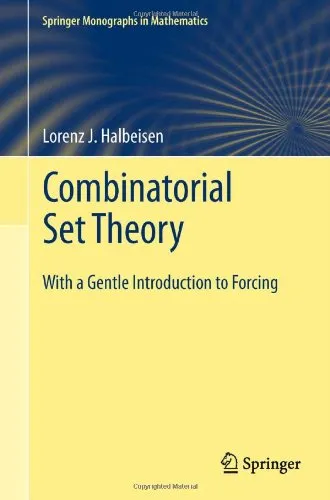
Combinatorial Set Theory: With a Gentle Introduction to Forcing
Lorenz J. Halbeisen (auth.)
2012
View book
RefHub featured
Book guide and evaluation
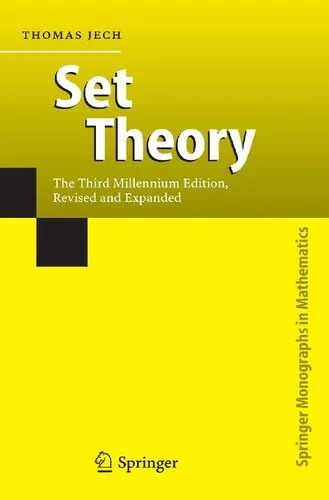
Thomas Jech
0 reviews
Published
pages
views
Introduction to "Set Theory: The Third Millennium Edition, Revised and Expanded" "Set Theory: The Third Millennium Edition, Revised and Expanded" by Thomas Jech is a comprehensive exploration of the fundamental principles and advanced concepts of set th
Before you read
"Set Theory: The Third Millennium Edition, Revised and Expanded" by Thomas Jech is a comprehensive exploration of the fundamental principles and advanced concepts of set theory, an essential branch of mathematical logic and the foundation of modern mathematics. This monumental text, now updated and thoroughly expanded for the third millennium, serves as an authoritative reference for students, researchers, and mathematicians who aim to deepen their understanding of the subject.
Praised for its clarity, rigor, and breadth, this edition incorporates new developments in set theory and reflects significant progress made in the field over recent decades. With a systematic approach to topics ranging from naive set theory to sophisticated concepts like forcing and large cardinals, the book provides readers with a robust framework for tackling some of the most challenging problems in mathematics and logic. This edition is an essential guide designed both for readers encountering set theory for the first time and for seasoned mathematicians seeking an advanced reference.
Below, we explore this significant work in detail through its summary, key takeaways, highlighted quotes, and the reasons why it remains a cornerstone of mathematical study.
The book begins with a comprehensive introduction to the basics of set theory, laying the groundwork with an exploration of sets, relations, and functions. It systematically builds on foundational topics such as Zermelo-Fraenkel axioms, ordinals, and cardinals, ensuring readers develop a complete understanding of the core elements of set theory. As the text progresses, it delves into advanced topics, including transfinite induction, choice principles (such as the Axiom of Choice), filters, ultrafilters, and combinatorics of infinite cardinals.
One of the highlights of the book is its detailed investigation of forcing and independence proofs, concepts that revolutionized our understanding of set-theoretic systems. The exposition is carefully structured, making even these intricate ideas accessible to those with sufficient mathematical background. Alongside these topics, the book thoroughly explores the concepts of large cardinals and determinacy, demonstrating their role in the broader mathematical context.
The revised and expanded edition incorporates new results and applications, reflecting the advancements made since the book was first published. Extra attention is given to modern developments, making this edition not only a thorough introduction but also an invaluable resource for advanced research in logic and mathematics.
"Mathematics, at its deepest level, is a study of structures, and set theory provides the universal language in which these structures are expressed."
"The concept of infinity, once a philosophical abstraction, finds rigorous expression in the language of set theory."
"Forcing, perhaps the most significant innovation in set theory of the last century, has reshaped our understanding of mathematical universes."
"Set Theory: The Third Millennium Edition, Revised and Expanded" is more than just a book—it's a bridge between foundational logic and the infinite complexity of mathematics. The text provides tools to understand critical ideas that permeate modern mathematical thought, from the rigorous study of infinite sets to the intricacies of constructing models and proving independence results. For students, it serves as a solid foundation; for researchers, a vital reference; and for educators, a teaching resource unparalleled in scope and clarity.
The significance of this book lies in its ability to make complex topics accessible without oversimplifying them. Its revisited edition ensures that the material remains relevant, incorporating modern insights and applications that have emerged over time. For anyone serious about understanding the architecture of mathematics, this book is indispensable.
Your question is answered in the context of this title and author. Each answer uses 2 points.
0 reviews, 4.3 average out of 5
Sign in to publish a review.
Ask a focused question and learn from the community.
Related references that continue this learning path.
Lorenz J. Halbeisen (auth.)
Michael Makkai,Gonzalo E. Reyes
Giovanna Corsi,Maria Luisa Dalla Chiara,Gian Carlo Ghirardi (Editors)