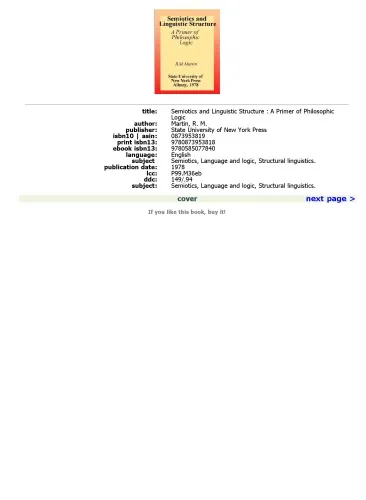
Book guide and evaluation
Semiotics and Linguistic Structure: A Primer of Philosophic Logic
Richard Milton Martin
English
Beginner
Art
3.7 / 5
0 reviews
1978
Published
343
pages
442
views
Introduction to 'Semiotics and Linguistic Structure: A Primer of Philosophic Logic' Welcome to an exploration of the intricate relationship between signs, language, and logic as presented in 'Semiotics and Linguistic Structure: A Primer of Philosophic Logic'. This book s
Before you read
What will you get from this book?
Introduction to 'Semiotics and Linguistic Structure: A Primer of Philosophic Logic'
Welcome to an exploration of the intricate relationship between signs, language, and logic as presented in 'Semiotics and Linguistic Structure: A Primer of Philosophic Logic'. This book serves as an essential guide for anyone delving into the depths of semiotics, language theory, and philosophical logic. It offers a comprehensive insight into how language structures thought and how semiotic systems underpin communication.
Detailed Summary of the Book
The book begins by laying the foundational concepts of semiotics, a study of signs and symbols as elements of communicative behavior. Semiotics is crucial in understanding how meaning is constructed and communicated. The author meticulously examines the arbitrariness of signs introduced by renowned linguist Ferdinand de Saussure and expands on Charles Sanders Peirce's triadic model comprising the sign, its object, and its interpretant.
Moving forward, the text delves into linguistic structures, elaborating on how languages impose an order that can influence cognitive processes. The theoretical frameworks of Noam Chomsky's generative grammar and Ludwig Wittgenstein's language games are analyzed, highlighting their relevance in understanding linguistic structures.
In the latter sections, the focus shifts to philosophic logic—the branch that addresses principles governing valid reasoning and argumentation. By combining linguistic theory with logical analysis, the book explores how philosophical arguments are constructed and evaluated, emphasizing the importance of logical form, consistency, and validity.
Key Takeaways
- The dynamic interplay between signs, language, and meaning is central to human interaction.
- Understanding semiotic and linguistic structures is essential for deciphering complex philosophical ideas.
- Logic provides a robust framework for analyzing and constructing coherent philosophical arguments.
- Insight into how language shapes thought can enhance cognitive and communicative practices.
Famous Quotes from the Book
"The essence of language is not the words themselves, but the system that governs the use of these signs."
"Logic is the backbone of reason; without it, the structure of thought collapses."
Why This Book Matters
'Semiotics and Linguistic Structure: A Primer of Philosophic Logic' matters because it bridges the gap between language and logic, offering readers an enriched understanding of how these domains interact. The significance of the book lies in its interdisciplinary nature, appealing to students of philosophy, linguistics, semiotics, and anyone interested in the architecture of thought and communication.
In a world driven by information and communication, grasping the underlying structures of language and logic is invaluable. As the digital age continues to expand, the principles outlined in this book provide critical tools for navigating and interpreting the vast networks of meaning that shape our daily lives.
Ask this book
Your question is answered in the context of this title and author. Each answer uses 2 points.
Sign in to ask the book assistant.
Reader reviews
0 reviews, 3.7 average out of 5
No reviews yet
If you have read this book, help the next reader with your experience.
Write a review
Sign in to publish a review.
Reader questions and answers
Ask a focused question and learn from the community.
Sign in to ask or answer a question.
No questions yet
Be the first to ask a clear, useful question.
What to read next
Related references that continue this learning path.