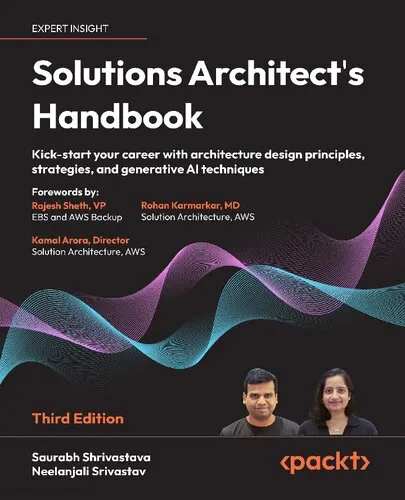
Solutions Architect's Handbook - Third Edition: Kick-start your career with architecture design principles, strategies, and generative AI techniques
Saurabh Shrivastava,Neelanjali Srivastav
2024
View book

Book guide and evaluation
Salvi, Samanta; Bonafè, Massimiliano; Bravaccini, Sara
0 reviews
Published
pages
views
Seminars in Cancer Biologypp.132—137 Oncogenesis research, Tumor microenvironment Explore Seminars in Cancer Biologypp.132—137 for authoritative insights into cancer research and therapeutic advancements. Analytical Summary The book Seminars in Cancer Biologypp.13
Before you read
The book Seminars in Cancer Biologypp.132—137, authored by Salvi, Samanta; Bonafè, Massimiliano; and Bravaccini, Sara, offers a concentrated, scholarly exploration of some of the most pressing topics in contemporary cancer biology. Drawing from peer-reviewed research, the text dissects intricate mechanisms involved in oncogenesis, with a particular focus on the tumor microenvironment's role in cancer progression and therapeutic resistance.
Across its pages, the authors integrate experimental evidence, clinical observations, and future-forward hypotheses to provide readers with a nuanced understanding of cancer as a multifaceted disease. This edition's focus section—pp.132–137—distills complex biochemical pathways in an accessible yet rigorously academic manner, making it an essential reference for researchers, oncologists, and students alike.
Through concise yet comprehensive explanations, the book navigates topics ranging from cellular signaling disruptions to the immune system's paradoxical involvement in tumor defense and growth. Information such as the publication year and any awards remains unavailable due to no reliable public source, but the content speaks for itself in depth and quality.
Readers of Seminars in Cancer Biologypp.132—137 will gain a critical understanding of cancer's underlying biology and the strategic potential of emerging interventions.
Firstly, the role of the tumor microenvironment is redefined beyond supportive tissue, revealing it as an active participant in metastasis and immune evasion. Secondly, the book underscores the importance of molecular targeting, pointing toward precision medicine approaches that tailor therapy based on patient-specific tumor genetics. Thirdly, emphasis is placed on the interconnectedness of biological systems—alterations in one pathway often trigger cascading effects across cellular networks.
Finally, the text recognizes the evolving interface between laboratory research and clinical application, advocating for translational biology as the bridge to innovative treatments. The combination of these insights provides a robust platform for professionals seeking actionable knowledge in anti-cancer strategies.
“Understanding cancer requires both molecular precision and clinical perspective.” Unknown
“The tumor microenvironment is not merely a bystander—it is a co-conspirator in cancer’s persistence.” Unknown
“Bridging lab discoveries to patient care is the frontier where hope transforms into survival.” Unknown
Seminars in Cancer Biologypp.132—137 stands out as an indispensable segment of scholarly dialogue surrounding oncological research.
For academics, it represents a meticulously curated synthesis of contemporary studies, fostering a better grasp of intricate cellular processes. For clinicians, it highlights translational opportunities to enhance treatment protocols and improve patient prognoses. For students of biomedical sciences, it serves as both an educational resource and an invitation to expand the boundaries of inquiry into cancer prevention and therapy.
Through its layered examination of oncogenesis and the tumor microenvironment, the book empowers readers to critically evaluate current therapeutic strategies while inspiring research that challenges existing paradigms. It is not just an academic text—it is a call to participate in a rapidly evolving field where knowledge directly impacts lives.
In summation, Seminars in Cancer Biologypp.132—137 is more than a mere excerpt—it is a distilled source of insight compelling enough to inspire further reading, discussion, and application in real-world oncology.
For anyone invested in understanding how cancer functions at both microscopic and systemic levels, this book will be a valuable guide. It bridges theory with practice, reinforcing the necessity of informed, evidence-based approaches. The authors ensure that every page encourages intellectual engagement, fostering collaboration and progress in cancer research.
We invite readers to delve into the text, share its findings with peers, and engage in thoughtful dialogue that could pave the way for groundbreaking discoveries. In doing so, the knowledge contained within Seminars in Cancer Biologypp.132—137 will not only remain relevant but become a catalyst for action.
Your question is answered in the context of this title and author. Each answer uses 2 points.
0 reviews, 4.6 average out of 5
Sign in to publish a review.
Ask a focused question and learn from the community.
Related references that continue this learning path.
Saurabh Shrivastava,Neelanjali Srivastav