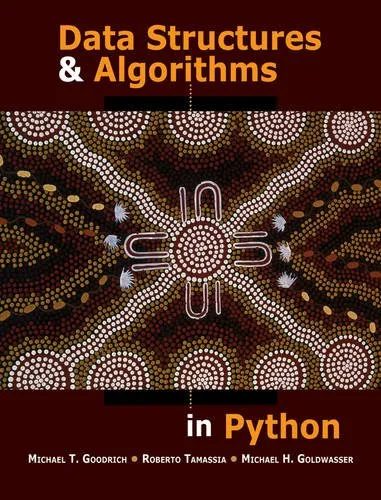
Data Structures and Algorithms in Python
Michael T. Goodrich,Roberto Tamassia,Michael H. Goldwasser
2013
View book
Book guide and evaluation
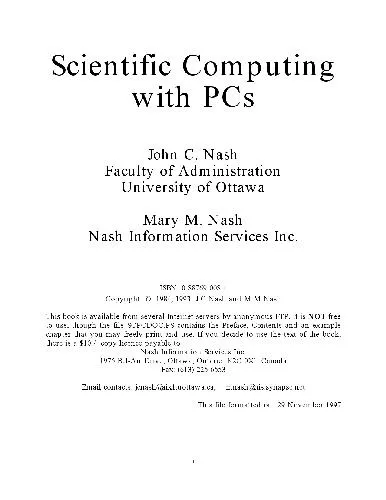
Nash J.C.,Nash M.M.
0 reviews
Published
pages
views
Welcome to an intricate exploration of 'Scientific Computing with PCs', a book that delves deep into the transformative power of personal computers as tools for scientific inquiry and computation. It’s a guide that provides unparalleled insight into harnessing the capabilitie
Before you read
Welcome to an intricate exploration of 'Scientific Computing with PCs', a book that delves deep into the transformative power of personal computers as tools for scientific inquiry and computation. It’s a guide that provides unparalleled insight into harnessing the capabilities of PCs for scientific applications, offering both novice and seasoned users the knowledge to enhance their computational efficiency.
In 'Scientific Computing with PCs', Nash J.C. and Nash M.M. reveal the potential of personal computers as invaluable resources in scientific computing. Once considered mere tools for word processing and simple calculations, PCs have evolved into powerful machines capable of complex data processing and analysis. The book starts by presenting a historical overview of computing, charting the evolution of computational technologies and their increasing accessibility. As you delve deeper, you’ll find detailed discussions on algorithms that are crucial for scientific computing. The authors provide a comprehensive walkthrough of numerical methods, optimization techniques, and data analysis, which form the backbone of scientific computations.
The book is meticulously structured to cater to the needs of both beginners and advanced users. Basic principles are covered in the initial chapters, with more advanced topics and applications discussed as the book progresses. Practical examples and case studies are included to demonstrate the application of theoretical concepts, providing readers with hands-on experience in tackling real-world problems. Moreover, programming with languages like Fortran and C is integrated into discussions, making it a go-to resource for those interested in refining their programming skills for scientific exploration.
The book equips readers with a solid foundation in:
"The transformation of the personal computer from a rudimentary tool into a powerhouse for scientific investigation is nothing short of remarkable."
"Understanding the mathematics of computation opens doors to new realms of discovery."
'Scientific Computing with PCs' stands as a testament to the growing intersection between computing technology and scientific progress. In an era where data is the new frontier, the ability to process and analyze vast amounts of information efficiently is invaluable. This book not only underscores the importance of PCs in contemporary scientific inquiry but also provides the tools and knowledge to make the most of these powerful resources.
For students, researchers, and professionals alike, the guidance offered within these pages is crucial for staying ahead in the ever-evolving field of scientific computing. By demystifying complex concepts and providing actionable insights, 'Scientific Computing with PCs' empowers its readers to push the boundaries of what is possible with technology, fostering innovation and precision in their work.
Your question is answered in the context of this title and author. Each answer uses 2 points.
0 reviews, 4.0 average out of 5
Sign in to publish a review.
Ask a focused question and learn from the community.
Related references that continue this learning path.
Michael T. Goodrich,Roberto Tamassia,Michael H. Goldwasser
Narasimha Karumanchi