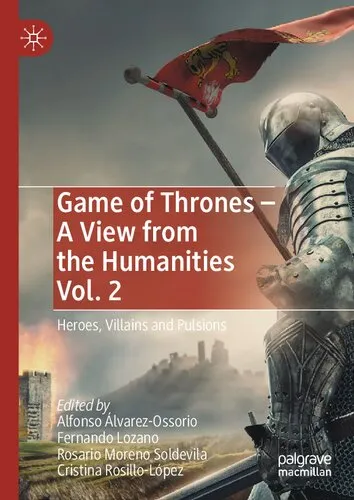
Game of Thrones - A View from the Humanities : Heroes, Villains and Pulsions
Alfonso Álvarez-Ossorio,Fernando Lozano,Rosario Moreno Soldevila,Cristina Rosillo-López
2023
View book
Book guide and evaluation
Huang, Xiang
0 reviews
Published
pages
views
Introduction to "Science in Contextpp.393—427" Welcome to the world of "Science in Contextpp.393—427," a thought-provoking exploration of the intricate and profound relationship between science and the broader cultural, ethical, and societal framework in which it thrives.
Before you read
Welcome to the world of "Science in Contextpp.393—427," a thought-provoking exploration of the intricate and profound relationship between science and the broader cultural, ethical, and societal framework in which it thrives. Authored by Huang, Xiang, this segment of a larger work unravels the compelling interactions and contexts that shape scientific discovery and its impacts on humanity. Through meticulous research and insightful analysis, readers are invited to traverse the multidimensional dynamics that define science as not just a pursuit of knowledge but as an entity closely interwoven with human life and progress.
"Science in Contextpp.393—427" delves deeply into the nuances of how science is influenced by, and simultaneously influences, the cultural and societal environments it operates within. The book proposes that scientific exploration cannot be understood in isolation; it is a product of its time and place. Historical events, philosophical paradigms, and ethical considerations are shown to play critical roles in shaping scientific endeavors and the application of newfound knowledge. Huang, Xiang carefully unpacks case studies and theoretical frameworks to demonstrate how scientific discoveries resonate far beyond laboratory confines, echoing through the realms of policy-making, education, and public perception.
The text explores the multifaceted interactions of key players, such as scientists, educators, policymakers, and society as a whole, highlighting the importance of viewing science as a living, breathing element of our culture. Huang emphasizes that progress in science often results from a feedback loop, wherein discoveries inspire cultural shifts, and those shifts further ignite curiosity and innovation. Readers will leave this work with a renewed sense of appreciation for the interconnected nature of science and human progress.
"Science, unbound by boundaries yet tethered to its context, resembles a river—its course shaped by the terrain but its essence forever fluid."
"The pursuit of knowledge is not just a solitary endeavor but a collaborative dance between curiosity and culture."
"Innovation without perspective risks being blind; context provides the vision necessary for meaningful progress."
"True societal advancement lies not in scientific discovery alone, but in how these discoveries resonate with, transform, and uplift humanity."
In an era where science continuously pushes the boundaries of what is possible, "Science in Contextpp.393—427" serves as a poignant reminder of the importance of perspective. Huang, Xiang's work matters because it encourages readers to not only celebrate scientific advancements but also critically assess their implications on society and culture. By understanding the context in which science operates, we gain the ability to navigate ethical dilemmas, inform responsible policymaking, and foster a culture of innovation that prioritizes humanity's collective well-being.
This book is especially relevant for educators, scientists, and policymakers, providing them with a conceptual framework that integrates science into the broader tapestry of human existence. For the casual reader, it offers profound insights that elevate one’s understanding of science beyond its technical aspects, inspiring a deeper appreciation of how knowledge transforms and uplifts civilization. Whether you are deeply entrenched in science or merely curious about its role in shaping the world, this book delivers timeless lessons that will resonate with all.
"Science in Contextpp.393—427" is not merely a piece of scholarly literature; it is a call to action—urging society to embrace science as a transformative force while remaining vigilant about its contextual implications.
Your question is answered in the context of this title and author. Each answer uses 2 points.
0 reviews, 3.8 average out of 5
Sign in to publish a review.
Ask a focused question and learn from the community.
Related references that continue this learning path.
Alfonso Álvarez-Ossorio,Fernando Lozano,Rosario Moreno Soldevila,Cristina Rosillo-López