

Book guide and evaluation
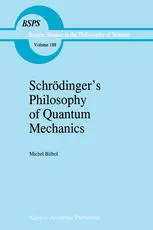
Schrödinger’s Philosophy of Quantum Mechanics
Michel Bitbol (auth.)
English
Beginner
Historical
4.8 / 5
0 reviews
1996
Published
300
pages
307
views
Schrödinger’s Philosophy of Quantum Mechanics "Schrödinger’s Philosophy of Quantum Mechanics" by Michel Bitbol is a profound exploration of the deeper philosophical implications inherent in the works and thoughts of one of quantum physics' foundational figures, Erwin
Before you read
What will you get from this book?
Schrödinger’s Philosophy of Quantum Mechanics
"Schrödinger’s Philosophy of Quantum Mechanics" by Michel Bitbol is a profound exploration of the deeper philosophical implications inherent in the works and thoughts of one of quantum physics' foundational figures, Erwin Schrödinger. By delving into Schrödinger's views, this book unveils the conceptual richness of quantum mechanics and its potential to challenge and enhance our understanding of reality itself. Far from mere technical formulations, Schrödinger's reflections reveal the philosophical depth required to comprehend the intricate intertwining of observer, observed, and the underlying nature of existence.
Detailed Summary
In an age where quantum mechanics revolutionized our understanding of physics, Erwin Schrödinger stood out not only for his scientific ingenuity but also for his philosophical insights. This book takes a deep dive into his perspectives, focusing on how he perceived quantum mechanics as more than a mathematical framework—it was, for him, a profound meditation on the unity of mind and nature.
Michel Bitbol introduces readers to Schrödinger's principle of "wave mechanics," a major pillar of quantum theory. However, the book goes further than recounting the technical achievements of Schrödinger. It peels back his philosophical standpoint, investigating how his thoughts were intertwined with traditions such as Vedantic philosophy, which influenced his interpretation of the unity of all existence. Schrödinger questioned the core tenets of classical physics like separability, locality, and objectivity, challenging us to revisit what it means to "observe" and "measure."
Featuring deep analyses of Schrödinger’s most significant philosophical writings, this book reveals how he critiqued certain interpretations of quantum mechanics (notably the Copenhagen interpretation) yet upheld their fundamental insights into the observer-dependent nature of phenomena. The discussion extends into Schrödinger's consciousness studies, showing how he refused to separate physics from the metaphysical and making him an advocate for the principle of the indissoluble unity of the world and subjective experiencing mind.
The narrative transitions seamlessly between intellectual history, scientific discussion, and philosophical discourse, making it a must-read for those who seek to understand not just the mechanics but the meaning of quantum theory.
Key Takeaways
- Schrödinger’s contributions extend beyond quantum mechanics to a holistic philosophy of reality, integrating science with metaphysics.
- The book emphasizes Schrödinger's rejection of strict dualism, advocating instead for the principle of oneness in nature.
- Highlights Schrödinger’s critiques of the Copenhagen interpretation while defending the core insights of quantum theory.
- Explores how Schrödinger's affinity for Eastern philosophical thought shaped his views on consciousness and the observer.
- Challenges readers to reflect on the philosophical implications of observing quantum phenomena.
Famous Quotes from the Book
"Quantum mechanics demands that we abandon the notion of a world that exists independently of our observation."
"Schrödinger’s philosophy calls us to unify mind and matter within a single, indivisible reality."
"What we observe as material bodies and forces are nothing but shapes and variations in the structure of the mind."
Why This Book Matters
The significance of "Schrödinger’s Philosophy of Quantum Mechanics" lies in its ability to bridge physics and philosophy seamlessly. At a time when quantum mechanics is often confined to technical use or pop-sci generalizations, Michel Bitbol revives the intellectual rigor and depth of Schrödinger’s holistic vision. The book is not merely a study of Schrödinger’s work; it’s a profound meditation on the nature of reality, urging us to reflect on questions such as: What role does the observer play in our understanding of the universe? Can physical laws exist independently of consciousness? By tackling Schrödinger’s philosophical musings, readers are invited to rethink the boundaries between the subjective and the objective.
This book is crucial for students of philosophy, physicists longing to rediscover the "why" behind the "how," and anyone intrigued by the profound questions quantum mechanics raises about existence itself. Bitbol’s scholarly approach draws readers closer not only to Schrödinger’s intellectual legacy but also to their own potential for understanding and existential clarity.
Ask this book
Your question is answered in the context of this title and author. Each answer uses 2 points.
Sign in to ask the book assistant.
Reader reviews
0 reviews, 4.8 average out of 5
No reviews yet
If you have read this book, help the next reader with your experience.
Write a review
Sign in to publish a review.
Reader questions and answers
Ask a focused question and learn from the community.
Sign in to ask or answer a question.
No questions yet
Be the first to ask a clear, useful question.
What to read next
Related references that continue this learning path.


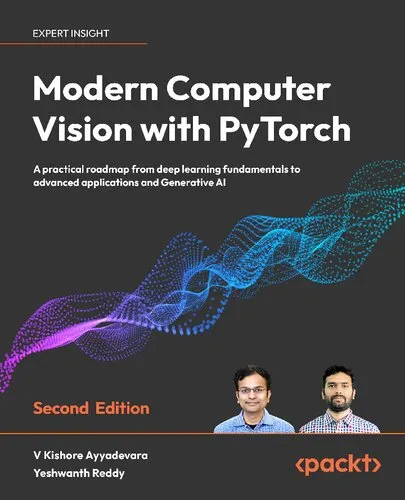
Modern Computer Vision with PyTorch: A Practical Roadmap From Deep Learning Fundamentals to Advanced Applications and Generative AI, 2nd Edition
V Kishore Ayyadevara,Yeshwanth Reddy
2023
View book