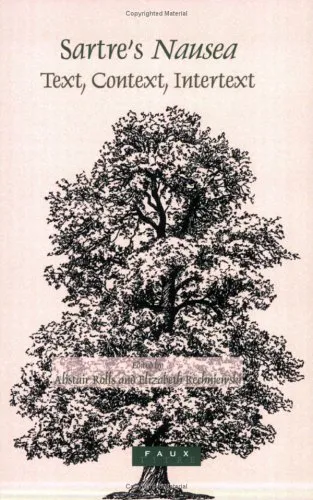
Book guide and evaluation
Sartre's ''Nausea'': Text, Context, Intertext (Faux Titre 273) (Faux Titre)
Alistair Rolls,Elizabeth Rechniewski
English
Intermediate
novel
5.0 / 5
0 reviews
2006
Published
222
pages
480
views
Welcome to the comprehensive guide to understanding and exploring Jean-Paul Sartre’s seminal work, 'Nausea'. Our book, 'Sartre's ''Nausea'': Text, Context, Intertext (Faux Titre 273)' delves into the multifaceted dimensions of Sartre's groundbreaking novel, offering insights in
Before you read
What will you get from this book?
Welcome to the comprehensive guide to understanding and exploring Jean-Paul Sartre’s seminal work, 'Nausea'. Our book, 'Sartre's ''Nausea'': Text, Context, Intertext (Faux Titre 273)' delves into the multifaceted dimensions of Sartre's groundbreaking novel, offering insights into its text, context, and intertextual connections.
Detailed Summary of the Book
Jean-Paul Sartre's 'Nausea' is more than a novel; it's a philosophical exploration into existential angst and the human condition. Our study situates the novel within its historical framework, examining the socio-political milieu of pre-World War II France. Sartre's narrative captures the existential crisis of Antoine Roquentin, a solitary figure ensnared in a profound sense of meaninglessness, encapsulated by the titular “nausea”—a visceral manifestation of existential dread.
The book opens with Roquentin, a historian by profession, who gradually becomes disenchanted with his life and work. This leads him to question the very nature of existence and being. In our analysis, we explore how Sartre's philosophical underpinnings, chiefly his concept of existentialism, are woven into the fabric of the story, guiding readers through Roquentin’s descent into existential paralysis and his eventual epiphany.
Key Takeaways
- Existential Exploration: Roquentin's journey is a quintessential exploration of existential themes, such as the absurdity of life, freedom, and isolation.
- Philosophical Foundations: The narrative is deeply rooted in Sartrean existentialism, echoing his broader philosophical discourse articulated in his other works like 'Being and Nothingness'.
- Intertextual Analysis: We offer a meticulous breakdown of the intertextual connections between 'Nausea' and other literary and philosophical compositions, shedding light on Sartre's inspirations and intellectual engagements.
- Cultural Contextualization: Insight into the historical and cultural contexts enhances the reader's comprehension of the existential themes Sartre interweaves with the narrative of personal and societal pre-war unease.
Famous Quotes from the Book
Sartre's mastery of prose and philosophy is evident through several memorable excerpts. Here are a few noteworthy quotes:
"I felt myself full of inhuman thoughts, of inhuman ideas. I was thinking that there was a ball of lead on the surface of the earth and it was me."
"I exist, that's all. And that trouble me profoundly, because I'm going to have to question myself endlessly."
"Life has no meaning the moment you lose the illusion of being eternal."
Why This Book Matters
Sartre's 'Nausea' is a cornerstone of existential literature, offering profound insight into the human psyche and the search for meaning in a seemingly indifferent universe. Through our exploration of the text, context, and intertext, readers are equipped with a deeper understanding of the philosophical inquiries that Sartre posed, which remain critically relevant in contemporary discourse. The novel’s exploration of free will and the nature of existence challenges readers to confront their perceptions of reality and self, establishing 'Nausea' as an enduring philosophical and literary touchstone.
This book matters because it not only provides a gateway into Sartre’s philosophical world but also serves as an invaluable tool for engaging with broader existential questions that continue to be pertinent today. Through our analysis, readers are invited to immerse themselves in a multi-layered reading experience that enriches their engagement with one of the 20th century's most profound pieces of literature.
Ask this book
Your question is answered in the context of this title and author. Each answer uses 2 points.
Sign in to ask the book assistant.
Reader reviews
0 reviews, 5.0 average out of 5
No reviews yet
If you have read this book, help the next reader with your experience.
Write a review
Sign in to publish a review.
Reader questions and answers
Ask a focused question and learn from the community.
Sign in to ask or answer a question.
No questions yet
Be the first to ask a clear, useful question.
What to read next
Related references that continue this learning path.