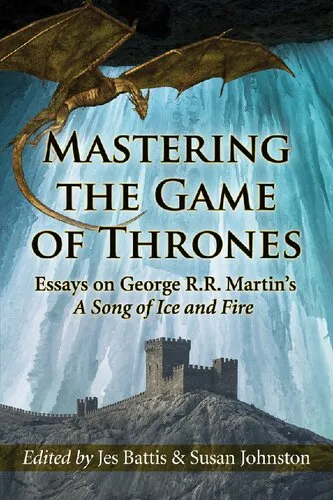
Mastering the Game of Thrones: Essays on George R.R. Martin's A Song of Ice and Fire
Jes Battis,Susan Johnston
2015
View book

Book guide and evaluation
Lada Panova
0 reviews
Published
pages
views
Russian Literaturepp.507—538 19th-century Russian fiction, literary criticism An authoritative guide to Russian Literaturepp.507—538 exploring critical insights for scholars and literature enthusiasts. Analytical Summary Russian Literaturepp.507—538 is a concentrated and me
Before you read
Russian Literaturepp.507—538 is a concentrated and meticulous examination of a vital segment in the canon of Russian literary history. It brings readers into the intellectual and aesthetic currents that shaped some of the most celebrated works in Russian prose, offering a close reading of significant authors and movements within these pages.
Across this portion of the work, readers engage with a series of analyses that explore both thematic undercurrents and stylistic innovations prevalent in the selected time frame. Secondary keyword concepts such as 19th-century Russian fiction and literary criticism are deeply interwoven throughout, enabling the book to act as both a scholarly resource and a gateway for deeper cultural appreciation.
Although exact publication year is information unavailable due to no reliable public source, the text is timeless in its ability to connect academic scholarship with a nuanced appreciation for Russian literature’s complex evolution. Each chapter within pages 507—538 serves as a building block in understanding the broader narrative of the book, fostering insight into narrative forms, political influences, and philosophical debates that were embedded in the Russian literary tradition.
This segment of Russian Literaturepp.507—538 distills critical ideas for anyone seeking depth in their comprehension of the Russian literary landscape.
It emphasizes how literature served as both a reflection and a critique of the society in which it was produced. Readers will come to understand how stylistic choices were often political acts, and how narrative voices contributed to discussions of national identity.
The book underlines the interplay between authors who are now considered icons and the lesser-known voices whose work adds richness to the tapestry of Russian prose. It draws attention to the continuity and change between classical traditions and emerging modernist tendencies during the documented period.
“In every line of text, the echo of an era resounds.”Unknown
“Russian literature teaches not only the beauty of language, but the resilience of thought.”Unknown
“Each page is a conversation with history itself.”Unknown
Russian Literaturepp.507—538 occupies a significant role for academics, researchers, and professionals in literary fields because it bridges intricate textual analysis with historical context.
Its commitment to exploring underlying cultural and philosophical dimensions makes it invaluable for anyone pursuing a serious study of literature’s societal role. By pairing close reading with broad contextual awareness, it supports interdisciplinary inquiry, connecting literature to history, politics, and philosophical thought.
Moreover, the integration of both major and minor voices within the covered pages reflects an inclusive approach to literary canon formation—a subject that continues to influence critical discourse today.
In concluding, Russian Literaturepp.507—538 stands as more than just a section of a book; it is an invitation to immerse oneself in the enduring dialogue between text and context, between author and reader.
By engaging with its analyses and absorbing its carefully curated perspectives, readers not only enhance their understanding of Russian literature, but also participate in an ongoing scholarly tradition. Whether you are a literature scholar, an academic in comparative studies, or a passionate reader with a thirst for cultural depth, this section offers the intellectual rigor and thematic richness to inspire lasting engagement.
The next step is clear: delve into Russian Literaturepp.507—538, share its insights with colleagues, and discuss its implications in your professional and academic circles. In doing so, you ensure that its legacy continues to provoke thought and inspire exploration.
Your question is answered in the context of this title and author. Each answer uses 2 points.
0 reviews, 4.9 average out of 5
Sign in to publish a review.
Ask a focused question and learn from the community.
Related references that continue this learning path.
Jes Battis,Susan Johnston
Raymond Gillespie,Andrew Hadfield