
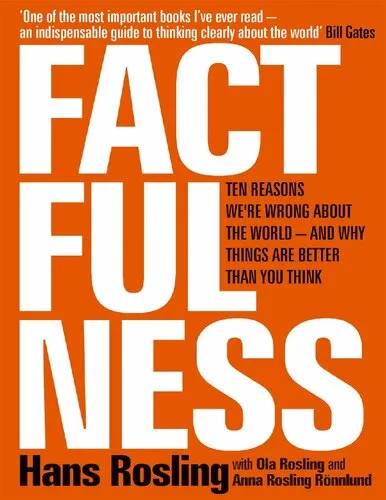
Book guide and evaluation
Rosling - Factfulness - 10 Reasons We’re Wrong About the World, and Why Things Are Better Than You Think.pdf
Rosling
English
Unordered
Economics
4.5 / 5
0 reviews
-
Published
349
pages
701
views
Introduction In a world awash with information, why do misconceptions still pervade our understanding of global progress? "Factfulness: Ten Reasons We're Wrong About the World—and Why Things Are Better Than You Think" challenges our collective misconceptions, offering a compel
Before you read
What will you get from this book?
Introduction
In a world awash with information, why do misconceptions still pervade our understanding of global progress? "Factfulness: Ten Reasons We're Wrong About the World—and Why Things Are Better Than You Think" challenges our collective misconceptions, offering a compelling narrative that decouples pessimism from reality. Authored by the late Hans Rosling, alongside his son Ola Rosling and daughter-in-law Anna Rosling Rönnlund, the book exposes the cognitive biases that skew our perceptions and provides a robust, fact-based view of the world.
Summary of the Book
The core of Factfulness is an examination of ten 'Instincts' that bias human thinking and contribute to widespread misunderstandings about the world. These instincts include the Gap Instinct, the Negativity Instinct, and the Straight Line Instinct, among others. Each chapter delves into one specific instinct, illustrating how it distorts our perspectives and how the world is genuinely progressing, often in ways that defy expectations.
The Gap Instinct, for example, reveals how we tend to think in binary oppositions—dividing the world into rich versus poor, developed versus developing. Rosling argues that this view is outdated and misleading, urging readers to recognize the nuanced landscape of global development. Similarly, the Negativity Instinct explains our proclivity to focus on negative events and headlines, despite data showing consistent improvements in fields such as health, education, and conflict reduction.
Through engaging anecdotes and vivid data visualization, Rosling dismantles these biases, encouraging a fact-based outlook on global development. The book not only challenges seasoned experts and casual readers alike but also empowers them to cultivate a factful mindset, grounded in reality and optimism.
Key Takeaways
- The Gap Instinct: Avoid thinking in extremes and seek the majority.
- The Negativity Instinct: Recognize that negative news does not equate to negative trends.
- The Straight Line Instinct: Be cautious of linear projections in a non-linear world.
- Factfulness: Embrace data-driven worldviews, challenging assumptions with facts and evidence.
The book empowers readers to reject dramatic worldviews and adopt a more balanced, factful approach. By understanding and navigating these instincts, individuals can make informed decisions, from personal lives to political choices, in an increasingly complex world.
Famous Quotes from the Book
"When we have a fact-based worldview, we can see that the world is not as bad as it seems—and we can see what we have to do to keep making it better."
"The world cannot be understood without numbers. And it cannot be understood with numbers alone."
Why This Book Matters
In an era characterized by information overload and polarization, Factfulness is a beacon of rationality. It challenges readers to rethink their assumptions, equipping them with the tools needed to interpret global statistics accurately. As information continues to proliferate, this book matters more than ever, reminding us that a factful perspective is not only preferable but necessary for effective global stewardship and personal peace of mind.
Rosling’s work goes beyond mere statistics; it’s a clarion call for embracing complexity and eschewing oversimplification. Whether you are an educator, policymaker, or global citizen, Factfulness is an indispensable resource for understanding the world as it truly is—and how we can collaboratively work towards its betterment.
Ask this book
Your question is answered in the context of this title and author. Each answer uses 2 points.
Sign in to ask the book assistant.
Reader reviews
0 reviews, 4.5 average out of 5
No reviews yet
If you have read this book, help the next reader with your experience.
Write a review
Sign in to publish a review.
Reader questions and answers
Ask a focused question and learn from the community.
Sign in to ask or answer a question.
No questions yet
Be the first to ask a clear, useful question.
What to read next
Related references that continue this learning path.

International Sales Law: A Guide to the CISG
Ingeborg Schwenzer;Christiana Fountoulakis;Mariel Dimsey
2019
View book

The Law of Damages in International Sales: The CISG and Other International Instruments
Djakhongir Saidov
2021
View book
Data analysis using hierarchical generalized linear models with R
Youngjo Lee,Lars Ronnegard,Maengseok Noh
2017
View book