
Book guide and evaluation
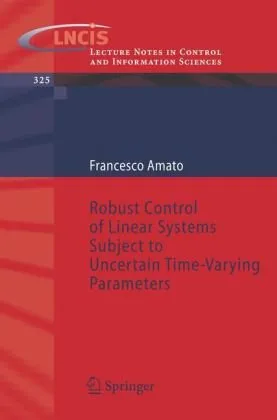
Robust Control of Linear Systems Subject to Uncertain Time-Varying Parameters
Francesco Amato Dr. (auth.)
English
Beginner
Engineering
4.9 / 5
0 reviews
2006
Published
200
pages
181
views
Introduction to "Robust Control of Linear Systems Subject to Uncertain Time-Varying Parameters" The book "Robust Control of Linear Systems Subject to Uncertain Time-Varying Parameters" offers a rigorous and comprehensive analysis of the challenges and methodologies involved
Before you read
What will you get from this book?
Introduction to "Robust Control of Linear Systems Subject to Uncertain Time-Varying Parameters"
The book "Robust Control of Linear Systems Subject to Uncertain Time-Varying Parameters" offers a rigorous and comprehensive analysis of the challenges and methodologies involved in designing control systems for linear systems under dynamic uncertainties. With a detailed exploration of robust control strategies, this book serves as an essential reference for researchers, practitioners, and students in control systems engineering. Let us delve deeper into what this book offers and why it holds a significant place in control theory literature.
Detailed Summary of the Book
The book systematically explores the robust control theory applied to linear systems impacted by uncertain parameters that evolve over time. It begins by addressing the critical issue of parametric variability, which is ubiquitous in real-world systems, from industrial machines to aerospace structures. These uncertainties often arise due to factors such as manufacturing imperfections, environmental changes, or operational wear-and-tear.
The central objective of the book is to present methods by which control systems can be designed to perform consistently and reliably, despite such unpredictable variations in parameters. Special emphasis is placed on the mathematical foundations of robust control, including linear matrix inequalities (LMIs) and parameter-dependent Lyapunov functions. Furthermore, the book thoroughly investigates state-space representations, parameter-dependent controller design, and existing methods for deriving stability and performance-oriented solutions.
What sets this book apart is its focus on practical applicability. While the theoretical frameworks are deeply explored, the discussion also emphasizes real-world scenarios and outlines ways to implement these control strategies in engineering systems. This dual approach bridges the gap between academic rigor and practical relevance, making the book uniquely valuable to a broad audience.
Key Takeaways
- An in-depth understanding of robust control principles for linear systems.
- A detailed introduction to analyzing and addressing uncertainty in time-varying parameters.
- Practical insights into controller design through the use of advanced mathematical tools such as LMIs.
- A unique blend of rigorous theory and real-world application methodologies.
- Strategies for ensuring the stability, performance, and reliability of dynamical systems operating under uncertain conditions.
Famous Quotes from the Book
"The hallmark of a robust system lies not in its immunity to uncertainty, but in its ability to mitigate and adapt to such uncertainties with precision and efficacy."
"Stability is not the culmination of control design but its foundation – a premise upon which performance and reliability are built, even under adversity."
Why This Book Matters
Control systems are at the heart of modern engineering, ensuring the safety and efficiency of everything from transportation to energy distribution. However, the inherent uncertainties in real-world systems pose profound challenges for engineers and researchers alike. This book addresses these challenges head-on, making a compelling case for the growing importance of robust control theory in today's complex technological landscape.
By focusing on time-varying uncertainties, the book tackles an area often overlooked in traditional control literature. Its emphasis on rigor, combined with practical insights, ensures that readers benefit not only from an understanding of foundational principles but also from actionable strategies. Moreover, the methodologies outlined in this book are poised to play a significant role as systems become increasingly autonomous, adaptive, and embedded in critical applications such as robotics, aerospace, and renewable energy.
In serving as a bridge between theoretical complexity and engineering practicality, this book is a valuable tool for aspiring engineers and seasoned professionals intent on mastering the art of robust control in uncertain environments.
Ask this book
Your question is answered in the context of this title and author. Each answer uses 2 points.
Sign in to ask the book assistant.
Reader reviews
0 reviews, 4.9 average out of 5
No reviews yet
If you have read this book, help the next reader with your experience.
Write a review
Sign in to publish a review.
Reader questions and answers
Ask a focused question and learn from the community.
Sign in to ask or answer a question.
No questions yet
Be the first to ask a clear, useful question.
What to read next
Related references that continue this learning path.

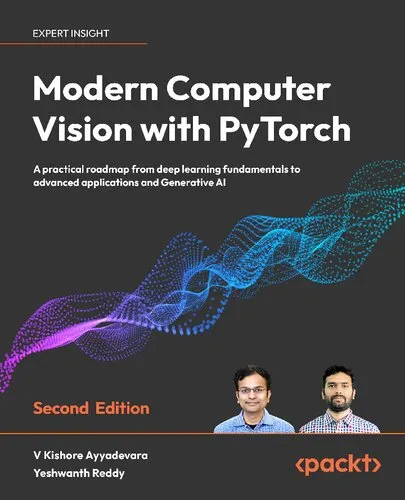
Modern Computer Vision with PyTorch: A Practical Roadmap From Deep Learning Fundamentals to Advanced Applications and Generative AI, 2nd Edition
V Kishore Ayyadevara,Yeshwanth Reddy
2023
View book