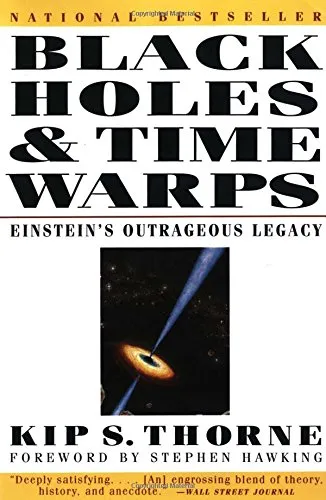
Black Holes and Time Warps: Einstein’s Outrageous Legacy
Kip S. Thorne,Stephen Hawking
1995
View book

Book guide and evaluation
Coltekin, Arzu;Hoffman, Robert R.;White, Raechel A
0 reviews
Published
pages
views
Introduction to "Remote Sensing and Cognition: Human Factors in Image Interpretation" Welcome to the intersection of remote sensing, cognitive science, and human factors research. "Remote Sensing and Cognition: Human Factors in Image Interpretation" delves
Before you read
Welcome to the intersection of remote sensing, cognitive science, and human factors research. "Remote Sensing and Cognition: Human Factors in Image Interpretation" delves into the essential yet often overlooked relationship between humans and the technology they interact with when interpreting remote sensing images. By focusing on the cognitive processes, human limitations, and decision-making involved in image interpretation, this book provides an integrated framework that bridges theory, practice, and interdisciplinary insight.
Remote sensing—capturing and analyzing data about the Earth's surface without direct physical contact—is a cornerstone of modern science and technology. From environmental monitoring and disaster response to military intelligence and urban planning, remote sensing applications are vast and diverse. However, despite advances in machine learning and automated approaches, human analysts remain critical to extracting actionable insights from remotely sensed data. This book examines the interplay of human cognition, expertise, and technology in this domain, offering readers a comprehensive view of both challenges and opportunities.
Whether you are a professional remote sensing analyst, a researcher interested in cognitive ergonomics, or simply curious about how humans make sense of highly complex visual data, this book is your guide to understanding and improving the image interpretation process.
This book is structured to explore human factors in image interpretation from both theoretical and practical perspectives. It begins by contextualizing remote sensing within the broader landscape of cognitive science and human-computer interaction. The foundational principles of perception, attention, memory, and decision-making are discussed in detail, revealing how these cognitive processes influence image analysis.
Chapters progress into examining the nature of expertise—how human analysts acquire skill and experience over time—and the common pitfalls and biases that affect even the most seasoned professionals. By drawing on empirical studies, case examples, and best practices, the book explores ways to enhance analyst performance, improve training, and mitigate errors during critical analyses.
The latter sections of the book shed light on technological advancements such as artificial intelligence (AI) and machine learning, evaluating the role these cutting-edge tools play when integrated with human decision-making. Rather than positioning humans and machines as competitors, the book emphasizes collaboration—fostering a synergistic relationship between human cognition and automated systems.
"The human mind remains the most advanced pattern recognition system ever created, yet it is not without its limitations."
"Expertise is not innate. It is built upon years of training, observation, and, most importantly, learning from mistakes."
"Machines may be faster, but they lack critical qualities such as judgment and adaptability—qualities that are uniquely human."
In a world increasingly reliant on data-driven insights, the human element often takes a backseat. This book argues that technology alone is insufficient for solving complex problems; human cognition and analytical skills are indispensable. By bridging cognitive science with remote sensing workflows, this book equips readers with the knowledge and strategies to enhance both human and system performance.
With decades of research and expertise informing the content, "Remote Sensing and Cognition: Human Factors in Image Interpretation" addresses a critical gap in the literature. By highlighting the strengths and limitations of human analysts, the authors provide actionable recommendations for practitioners, educators, technologists, and decision-makers.
This book matters because it advocates for a balanced approach in remote sensing—one that recognizes the value of human insight while embracing the potential of technological advancements. It is a timely reminder that at the heart of every system, process, and decision, there is a human mind striving to make meaning in an ever-changing world.
Your question is answered in the context of this title and author. Each answer uses 2 points.
0 reviews, 4.7 average out of 5
Sign in to publish a review.
Ask a focused question and learn from the community.
Related references that continue this learning path.
Kip S. Thorne,Stephen Hawking