Book guide and evaluation
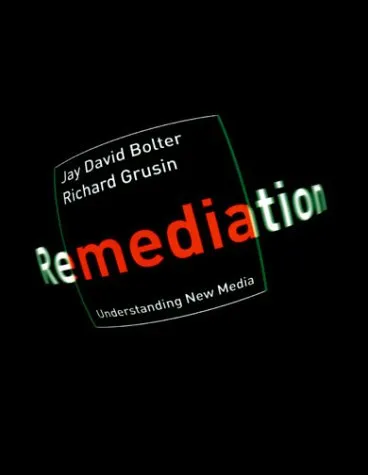
Remediation: understanding new media
Jay David Bolter,Richard Grusin
English
Intermediate
Technology
4.5 / 5
0 reviews
2000
Published
282
pages
833
views
Introduction to 'Remediation: Understanding New Media' Published in 1999, 'Remediation: Understanding New Media' by Jay David Bolter and Richard Grusin explores the fascinating interplay between old and new media. The concept of 'remediation' provides a lens through which we c
Before you read
What will you get from this book?
Introduction to 'Remediation: Understanding New Media'
Published in 1999, 'Remediation: Understanding New Media' by Jay David Bolter and Richard Grusin explores the fascinating interplay between old and new media. The concept of 'remediation' provides a lens through which we can understand how emerging media forms evolve by incorporating, refashioning, and responding to their predecessors.
Detailed Summary of the Book
At the core of 'Remediation: Understanding New Media' is the idea that media technologies are interconnected and that newer forms often refashion older ones. Bolter and Grusin posit that new media does not replace old media entirely but instead reimagines and redefines it. This process, which they term 'remediation,' is characterized by the dual logic of immediacy and hypermediacy. Immediacy strives to make the viewer forget the presence of the medium to create a seamless experience, while hypermediacy multiplies representations to remind the viewer of the medium.
The text delves into historical instances of remediation, providing examples from the Renaissance to the digital age to underscore that this pattern is deeply rooted in the media landscape. Through these case studies, Bolter and Grusin demonstrate that each emergent media form takes something from the past, reformulating previous media into its structure, style, and function. The relevance of the book's exploration is found in its analysis of digital technologies, such as virtual reality, computer graphics, and the Internet, which were in earlier stages of development at the time of writing. The authors illustrate how these technologies exemplify remediation by integrating elements from photography, television, film, and print media.
Key Takeaways
- The concept of remediation: new media refashion older media, a process that is ongoing throughout media history.
- Immediacy vs. hypermediacy: the two logics that drive the consumption and production of media, encompassing both the desire for an unmediated experience and self-awareness of the medium.
- Historical perspective: remediation is not a modern phenomenon but has roots that reach back centuries, influencing the way we interact with contemporary technologies.
- The relational aspect of technology: understanding new media requires analyzing their relation to preceding forms.
Famous Quotes from the Book
"What is new about new media comes from the particular ways in which they refashion older media and the ways in which older media refashion themselves to answer the challenges of new media."
"Immediacy and hypermediacy express themselves as contrary strategies: one tending toward transparency, the other toward opacity."
Why This Book Matters
Bolter and Grusin's exploration of remediation offers a critical framework for understanding media evolution, making 'Remediation: Understanding New Media' a seminal work for students, educators, and practitioners in media studies and communication. As digital technologies rapidly evolve, the insights offered by the book remain relevant, providing clarity on how media forms influence one another. The work challenges readers to think critically about the technological developments that shape our interaction with information and entertainment, highlighting the dynamic, cyclical nature of media evolution.
By dissecting remediation processes, this book empowers readers to better understand the complexities of media convergence and transformation, important for navigating the ever-changing media landscape today.
Ask this book
Your question is answered in the context of this title and author. Each answer uses 2 points.
Sign in to ask the book assistant.
Reader reviews
0 reviews, 4.5 average out of 5
No reviews yet
If you have read this book, help the next reader with your experience.
Write a review
Sign in to publish a review.
Reader questions and answers
Ask a focused question and learn from the community.
Sign in to ask or answer a question.
No questions yet
Be the first to ask a clear, useful question.
What to read next
Related references that continue this learning path.
New Media - A Critical Introduction
Martin Lister,Jon Dovey,Seth Giddings,Iain Grant,Kieran Kelly
2009
View book