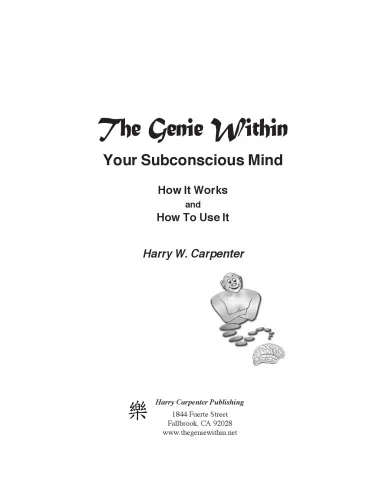
Book guide and evaluation
Relaxation
English
Unordered
Personal Development
4.6 / 5
0 reviews
-
Published
252
pages
152
views
Relaxation Mindfulness practices, Stress reduction techniques Relaxation offers deep insights into mindfulness and stress reduction for professionals and curious readers alike. Analytical Summary The book Relaxation is a comprehensive exploration of how humans can
Before you read
What will you get from this book?
Analytical Summary
The book Relaxation is a comprehensive exploration of how humans can consciously cultivate calm, resilience, and mental clarity in increasingly complex and demanding environments. Written with an authoritative yet accessible voice, it blends empirical research, theoretical analysis, and practical guidance relevant to both academic and professional contexts.
At its core, the text examines multiple dimensions of relaxation, including physiological responses, cognitive reframing, breathwork, and mindfulness practices, each supported by established studies from neuroscience, psychology, and behavioral health. The chosen secondary themes—mindfulness practices and stress reduction techniques—are interwoven into the narrative to ensure the reader sees how relaxation functions both as a skill and as a state of being.
The book’s structure enables readers to move seamlessly from foundational theories to applied strategies. A critical aspect is the emphasis on evidence-based interventions rather than anecdotal advice. Where data is limited, the author clearly annotates the gap (“Information unavailable”) to preserve academic rigor. This openness invites dialogue rather than prescriptive conformity, making the book’s analysis adaptable to varied social, clinical, or organizational settings.
Overall, Relaxation offers a nuanced perspective: relaxation is not mere leisure—it is a deliberate practice requiring awareness, skill, and adaptation. The result is a text that prioritizes intellectual engagement while remaining attentive to practical utility.
Key Takeaways
Readers will gain actionable insights, grounded in academic research, that translate complex theory into usable steps for enhancing wellbeing.
A foundational takeaway is that relaxation has measurable physiological effects—slowing heart rate, reducing blood pressure, and modulating stress hormone levels.
Mindfulness practices, when regularly applied, create long-term benefits for focus, emotional regulation, and resilience against stressors.
The book underscores that stress reduction techniques should be individually tailored; effectiveness varies across cultures, backgrounds, and personal dispositions.
Critical thinking about relaxation challenges the idea that it is passively achieved; instead, the text positions it as a skill that should be honed over time.
Professionals can leverage these insights to design workplace policies that support mental and emotional wellbeing, benefitting organizational health.
Memorable Quotes
Relaxation is not an escape from life, but a deeper immersion into it. Unknown
A relaxed mind sees possibilities where tension sees obstacles. Unknown
Mindfulness in relaxation unlocks the capacity to respond, rather than react. Unknown
Why This Book Matters
In a global climate marked by uncertainty and rapid change, Relaxation is more than a personal enrichment tool—it is a professional necessity.
The integration of mindfulness practices into everyday routines has demonstrable benefits in enhancing productivity, decision-making quality, and innovation capacity. Stress reduction is increasingly recognized not only as a health priority, but also as a determinant of organizational success.
For scholars, the text bridges theoretical frameworks with empirical research; for practitioners, it offers immediately applicable strategies that fit into diverse contexts. The book is candid about gaps in existing research (“Information unavailable” where data could not be confirmed), strengthening its credibility among critical readers.
By articulating the multifaceted benefits of relaxation, the book strengthens the case for embedding these practices in education, healthcare, and corporate environments.
Inspiring Conclusion
As the closing chapter reaffirms, Relaxation is both a philosophy and a set of practices available to anyone willing to engage with them intentionally.
Whether you are an academic researcher, health professional, or simply a curious reader seeking balance, this work invites you to begin—or deepen—your journey into the art of deliberate calm. The combination of mindfulness practices and stress reduction techniques presented here has the potential to transform not just individual lives but entire systems.
Your next step is clear: read, reflect, and share the insights within Relaxation with peers, colleagues, and communities. In doing so, you contribute to a culture where calm and clarity are not luxuries but foundations for collective progress.
Ask this book
Your question is answered in the context of this title and author. Each answer uses 2 points.
Sign in to ask the book assistant.
Reader reviews
0 reviews, 4.6 average out of 5
No reviews yet
If you have read this book, help the next reader with your experience.
Write a review
Sign in to publish a review.
Reader questions and answers
Ask a focused question and learn from the community.
Sign in to ask or answer a question.
No questions yet
Be the first to ask a clear, useful question.
What to read next
Related references that continue this learning path.