
Understanding Soft Condensed Matter Via Modeling and Computation (Series in Soft Condensed Matter 3)
Wenbing Hu,An-Chang Shi,Editors
2010
View book
Book guide and evaluation
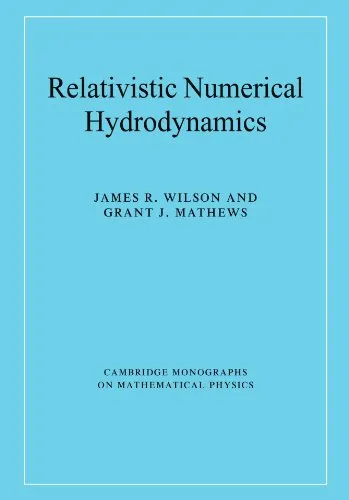
James R. Wilson,Grant J. Mathews
0 reviews
Published
pages
views
Introduction to Relativistic Numerical Hydrodynamics The realm of high-energy astrophysical phenomena such as supernovae, neutron stars, and black holes, demands a thorough understanding of relativistic fluid dynamics in curved spacetime. "Relativistic Numerical Hydrodynam
Before you read
The realm of high-energy astrophysical phenomena such as supernovae, neutron stars, and black holes, demands a thorough understanding of relativistic fluid dynamics in curved spacetime. "Relativistic Numerical Hydrodynamics", authored by James R. Wilson and Grant J. Mathews, serves as a cornerstone in the field, bridging the gap between the theoretical foundations of relativistic hydrodynamics and its computational methodologies. This book provides readers with not only the essential theoretical principles but also practical numerical techniques required to investigate and simulate complex relativistic systems. In this introduction, let us delve into the major dimensions of the book, highlighting a detailed summary, key takeaways, impactful quotes, and the importance of this work in scientific research.
"Relativistic Numerical Hydrodynamics" begins by establishing the essential groundwork in Einstein's theory of General Relativity and its implications for hydrodynamic systems. The authors introduce key concepts like the Einstein field equations and the role of relativistic equations of state. This theoretical framing is complemented by detailed derivations of the governing equations for relativistic fluids, which include the energy-momentum tensor, Baryonic conservation laws, and entropy evolution.
A significant portion of the book is dedicated to computational techniques used to solve these highly nonlinear equations in dynamic spacetime environments. Topics such as finite difference and finite volume methods, shock-capturing schemes, and advanced algorithms for radiation transport are meticulously explained. The text also covers numerical stability, accuracy, and boundary conditions that are both physically accurate and computationally efficient.
The book moves beyond traditional hydrodynamics, addressing multi-dimensional simulations of astrophysical phenomena like core-collapse supernovae, compact binary mergers, and gamma-ray bursts. It includes practical discussions on implementing these techniques using modern programming languages and high-performance computing frameworks.
Wilson and Mathews ensure that their theoretical foundations are always contextualized with real-world applications. Readers are equipped to simulate astrophysical phenomena under extreme conditions, interpret numerical results correctly, and drive new scientific discoveries.
"The study of relativistic hydrodynamics is, at its heart, an intersection of the vast tapestry of spacetime with the intricate dynamics of matter."
"Numerical simulations of relativistic systems transform abstract mathematical constructs into powerful tools of scientific discovery."
"Relativistic Numerical Hydrodynamics" holds a unique position in scientific literature by merging two advanced disciplines: General Relativity and Numerical Fluid Mechanics. Its significance lies not only in its rigorous treatment of the subject but also in its emphasis on practical applications. This book empowers researchers to model phenomena that exist at the limits of our observable universe—places where relativistic effects cannot be ignored.
As the astrophysical community increasingly relies on multi-messenger observations, including gravitational waves and electromagnetic signals, the ability to simulate compact objects and high-energy processes has never been more critical. Wilson and Mathews provide the core tools and understanding necessary to engage with this frontier of research. This book is an indispensable resource for seasoned astrophysicists, computational physicists, and graduate students venturing into numerical relativity and high-energy astrophysics.
By offering a bridge between theoretical insights and computational practices, "Relativistic Numerical Hydrodynamics" contributes to a deeper knowledge of the cosmos, fostering advancements in both fundamental science and practical technology. It is a must-read for anyone aiming to expand their horizons in the study of extreme physical systems.
Your question is answered in the context of this title and author. Each answer uses 2 points.
0 reviews, 4.0 average out of 5
Sign in to publish a review.
Ask a focused question and learn from the community.
Related references that continue this learning path.
Wenbing Hu,An-Chang Shi,Editors

Einstein, Albert;Greene, Brian