Machine Intelligence and Knowledge Engineering for Robotic Applications
Azriel Rosenfeld (auth.),Andrew K. C. Wong,Alan Pugh (eds.)
1987
View book
Book guide and evaluation
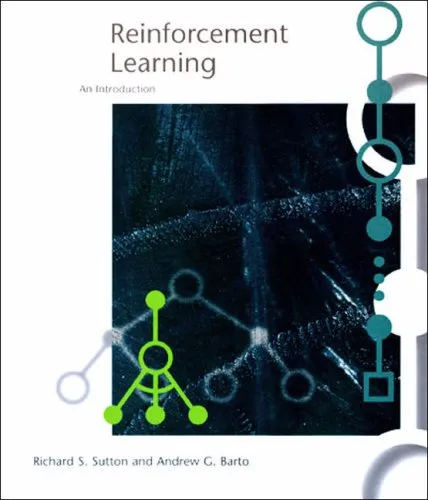
Richard S. Sutton,Andrew G. Barto
0 reviews
Published
pages
views
Introduction Welcome to an in-depth exploration of "Reinforcement Learning: An Introduction." This book, penned by the distinguished authors Richard S. Sutton and Andrew G. Barto, serves as a seminal resource in the field of artificial intelligence. It profoundly d
Before you read
Welcome to an in-depth exploration of "Reinforcement Learning: An Introduction." This book, penned by the distinguished authors Richard S. Sutton and Andrew G. Barto, serves as a seminal resource in the field of artificial intelligence. It profoundly delves into the intricacies of reinforcement learning (RL), offering both theoretical insights and practical applications that have shaped how AI systems learn from interaction.
"Reinforcement Learning: An Introduction" provides a comprehensive overview of the fundamental concepts and methodologies underlying reinforcement learning. The book is structured to cater to both novices and seasoned practitioners in the field of machine learning. It initiates the reader into the world of RL with basic concepts such as the reinforcement learning problem, which includes the notions of agents, environments, states, actions, and rewards.
As the reader progresses, the book introduces essential methods for learning from interaction, like dynamic programming, Monte Carlo methods, and temporal-difference learning. Detailed explanations are complemented with algorithms and examples, making it easier for readers to digest complex topics. Sutton and Barto effectively illustrate how RL can be applied to various real-world scenarios, including game-playing, robotics, and autonomous control systems.
Further sections delve into advanced subjects such as function approximation, eligibility traces, policy gradient methods, and the integration of RL with other machine learning paradigms. Each chapter builds on the last, culminating in a holistic understanding of both the potential and limitations of reinforcement learning.
"Reinforcement Learning: An Introduction" offers a wealth of knowledge, fundamental to grasping the following key takeaways:
Throughout the book, Sutton and Barto encapsulate the essence of reinforcement learning with insightful quotes:
"The best thing we can do is to keep learning and keep looking at things the world has to teach us."
"Reinforcement learning is the first computational approach to trying to make general principles to learn and predict, which is not in a supervised way."
"Reinforcement Learning: An Introduction" is not just a book but a cornerstone for anyone venturing into artificial intelligence and machine learning. The field of reinforcement learning is critical for building systems that can autonomously learn and adapt, which is pivotal for advancements in AI. Sutton and Barto’s work is cherished for its clarity and depth, making complex ideas accessible without sacrificing rigor.
As industries progress towards more intelligent systems, understanding reinforcement learning is imperative. This book acts as a guide, instilling a foundational comprehension of how learning from interaction can drive innovation in areas such as autonomous vehicles, robotics, healthcare, and finance. Its relevance is ever-growing in an era where machines are expected to perform increasingly sophisticated tasks.
Ultimately, "Reinforcement Learning: An Introduction" remains an essential read for those aspiring to contribute to the frontier of technology and artificial intelligence.
Your question is answered in the context of this title and author. Each answer uses 2 points.
0 reviews, 5.0 average out of 5
Sign in to publish a review.
Ask a focused question and learn from the community.
Related references that continue this learning path.
Azriel Rosenfeld (auth.),Andrew K. C. Wong,Alan Pugh (eds.)
John A. Hertz,Anders S. Krogh,Richard G. Palmer
Pramod K. Varshney (auth.),Rasiah Logananthara,Günther Palm,Moonis Ali (eds.)