Book guide and evaluation
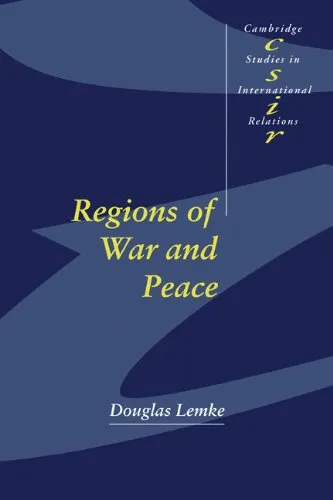
Regions of War and Peace
Douglas Lemke
English
Intermediate
novel
3.6 / 5
0 reviews
2002
Published
254
pages
580
views
Introduction to 'Regions of War and Peace' Welcome to the intricate exploration of global conflict and harmony as presented in 'Regions of War and Peace'. Authored by Douglas Lemke, this book delves into the complex interplay between regional dynamics and international rel
Before you read
What will you get from this book?
Introduction to 'Regions of War and Peace'
Welcome to the intricate exploration of global conflict and harmony as presented in 'Regions of War and Peace'. Authored by Douglas Lemke, this book delves into the complex interplay between regional dynamics and international relations, offering readers a comprehensive understanding of why some areas of the world experience persistent peace while others endure ongoing conflicts.
Detailed Summary
In 'Regions of War and Peace', Douglas Lemke tackles the profound question of what causes war and peace to prevail in different regions of the world. Through meticulous research and analysis, Lemke challenges prevailing theories of international relations by applying a regional perspective. The book argues that existing theories often overlook the significance of regional subsystems in influencing global stability. Lemke employs a framework that examines geopolitical zones, considering historical, social, economic, and political contexts that contribute to regional pacification or turmoil.
The book is strategically organized to cover various geographical regions, including detailed case studies that highlight how regional characteristics affect conflict patterns. Lemke explores regions such as Southeast Asia, Africa, and the Middle East, revealing contrasting paradigms of war and peace. By integrating empirical data and theoretical insights, Lemke provides a nuanced explanation of how power distributions, regional hegemonies, and intra-regional relations impact both the prevalence and resolution of conflicts.
Key Takeaways
- Regional dynamics play a critical role in the outcomes of war and peace, often overshadowing global paradigms.
- Each region possesses unique historical and political contexts that significantly impact its conflict or peace status.
- Traditional international relations theories must incorporate regional subsystems to provide comprehensive explanations.
- Power asymmetries and regional hegemonies can either drive conflict or establish stability.
- Empirical case studies offer evidence that supports the framework suggested by Lemke, emphasizing the importance of regional analysis.
Famous Quotes from the Book
"Understanding the geopolitics of regions is essential for comprehending the broader patterns of international peace and conflict."
"Regions are not merely pieces of a puzzle; they are pivotal forces that shape the entire image of global order."
Why This Book Matters
'Regions of War and Peace' stands out as a crucial text for scholars, students, and anyone interested in international relations and conflict studies. By shifting the focus from global-centric theories to region-specific analyses, Lemke offers a refreshing perspective that acknowledges the diversity and complexity inherent in global politics. This book is invaluable for policymakers seeking to address regional conflicts effectively, as it outlines the profound impact of regional systems on global stability. Additionally, Lemke's work serves as a scholarly bridge to understanding the multifaceted causes of war and peace beyond traditional theoretical frameworks.
Ask this book
Your question is answered in the context of this title and author. Each answer uses 2 points.
Sign in to ask the book assistant.
Reader reviews
0 reviews, 3.6 average out of 5
No reviews yet
If you have read this book, help the next reader with your experience.
Write a review
Sign in to publish a review.
Reader questions and answers
Ask a focused question and learn from the community.
Sign in to ask or answer a question.
No questions yet
Be the first to ask a clear, useful question.
What to read next
Related references that continue this learning path.
The Brothers Karamazov (Vintage Classics) (Everyman's Library, #70)
Fyodor Dostoyevsky, Richard Pevear, Larissa Volokhonsky;Malcolm V. Jones
1992
View book