

Continuous Delivery: Reliable Software Releases through Build, Test, and Deployment Automation
Jez Humble,David Farley
2010
View book
RefHub featured
Book guide and evaluation
Scott W. Ambler,Pramodkumar J. Sadalage
0 reviews
Published
pages
views
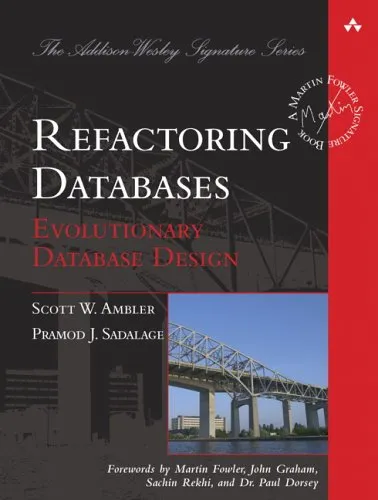
Refactoring Databases: Evolutionary Database Design In the ever-evolving world of software development, adapting to change is crucial. "Refactoring Databases: Evolutionary Database Design" by Scott W. Ambler and Pramodkumar J. Sadalage presents a pragmatic approach to database
Before you read
In the ever-evolving world of software development, adapting to change is crucial. "Refactoring Databases: Evolutionary Database Design" by Scott W. Ambler and Pramodkumar J. Sadalage presents a pragmatic approach to database design that focuses on enabling innovation while maintaining data integrity. This book breaks the traditional conventions of static database structures and introduces agile methodologies to database management.
The book addresses the critical challenge of evolving database schemas while preserving the integrity and quality of the software. It provides detailed methodologies, patterns, and practices designed to integrate database refactoring into the agile software development process. Ambler and Sadalage emphasize the importance of treating database schemas with the same level of attention as application code. The text introduces the concept of database refactorings which are small changes made to a database schema, preserving its behavior. The authors illustrate how to implement these transformations, enabling developers to continuously adapt to the evolving requirements of business applications. The book is structured to guide developers from understanding the fundamentals of database refactoring to applying complex refactoring patterns in real-world scenarios. It outlines how to gracefully transition from legacy schemas to more efficient designs, without disrupting the business operations.
"The database is an evolving part of the software system, not an unchanging foundation."
"Refactoring is a series of small changes to a database schema that improve its design without altering its functionality."
In today's competitive tech landscape, businesses are required to be more agile than ever. This book provides an essential toolkit for software developers and database administrators who need to align their database designs with Agile principles and practices. It fills a crucial gap in the literature by focusing on the synergy between agile software development and database management, thereby promoting continuous improvement in database design. Users of this book will gain profound insights into the technical, cultural, and organizational changes required to successfully implement evolutionary database design. The approach not only enhances the adaptability of database systems to changing business needs but also fosters a culture of collaboration among teams. This transforms database management from a bottleneck to a facilitator of business agility.
Persian Summary
Your question is answered in the context of this title and author. Each answer uses 2 points.
0 reviews, 3.7 average out of 5
Sign in to publish a review.
Ask a focused question and learn from the community.
Related references that continue this learning path.
Jez Humble,David Farley

Pramod J. Sadalage,Martin Fowler