

Book guide and evaluation
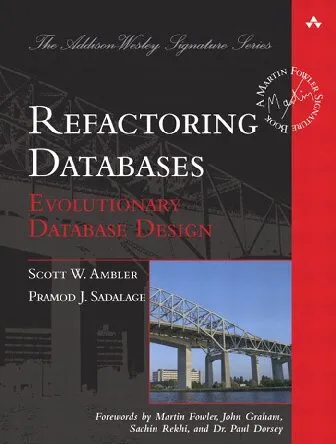
Refactoring Databases: Evolutionary Database Design (Addison-Wesley Signature Series (Fowler))
Scott J Ambler,Pramod J. Sadalage
English
Beginner
Software Engineering
4.5 / 5
0 reviews
2006
Published
386
pages
269
views
Introduction to "Refactoring Databases: Evolutionary Database Design" In the ever-evolving world of software development, database design often lags behind the fast-paced changes of application code. "Refactoring Databases: Evolutionary Database Design" by Scott J. Ambler
Before you read
What will you get from this book?
Introduction to "Refactoring Databases: Evolutionary Database Design"
In the ever-evolving world of software development, database design often lags behind the fast-paced changes of application code. "Refactoring Databases: Evolutionary Database Design" by Scott J. Ambler and Pramod J. Sadalage takes a groundbreaking approach to address this challenge. This book bridges the gap between application developers and database professionals, offering practical strategies and techniques to modernize database architectures while maintaining data integrity. It empowers organizations to evolve their databases incrementally with minimal disruption, enabling innovation and sustainable software systems.
Detailed Summary of the Book
"Refactoring Databases: Evolutionary Database Design" centers on the idea that just like application code, databases need to evolve in small, manageable steps. The authors introduce the concept of database refactoring, a systematic approach to making incremental, non-breaking improvements to database schemas. Each refactoring action refines the database structure without compromising its existing behavior. They provide real-world examples and step-by-step guidance on executing refactorings, ensuring that the database aligns with the evolving requirements of modern software systems.
The book is structured to address both the theoretical and practical aspects of evolutionary database design. It begins by discussing the fundamental principles behind database refactoring, including collaboration between developers and DBAs, continuous integration, and automated testing. The authors then explore the catalog of database refactorings, providing concrete examples of schema evolution techniques like renaming columns, splitting tables, and introducing surrogate keys.
Through insightful case studies and hands-on examples, the book elevates database development from a static process to a dynamic and agile practice. It also emphasizes the importance of automating database refactoring processes to reduce human errors and improve efficiency. Overall, the book serves as a definitive guide for professionals who aim to bring modern software development practices to the database layer.
Key Takeaways
- Discover the principles and practices of evolutionary database design.
- Learn how to perform database refactorings safely and effectively.
- Understand how to build a culture of collaboration between developers and DBAs.
- Explore techniques for automating the database refactoring process.
- Gain insights into handling legacy databases and aligning them with modern development strategies.
Famous Quotes from the Book
"The most effective way to produce working software is to iterate quickly and adjust continuously. The same principle applies to database design."
"Database refactoring is about making incremental changes safely, to make your database easier to work with without impacting its behavior."
"Agility isn’t just for developers; it’s for everyone in the team, including database professionals."
Why This Book Matters
The significance of "Refactoring Databases: Evolutionary Database Design" lies in its potential to revolutionize how organizations approach database development. In traditional settings, databases are often treated as rigid structures that require extensive planning and upfront design. This book challenges that norm by introducing the agile mindset to database management, making software systems more adaptable and resilient to change.
By fostering collaboration between developers and database administrators, the book promotes a culture of shared responsibility for maintaining and evolving database systems. This collaborative approach not only reduces friction but also ensures that changes to the database align with current and future application requirements.
In an age where data is at the core of business decisions and application functionality, this book equips teams with the tools to create robust, scalable, and maintainable database systems. Its practical advice and actionable strategies make it indispensable for software developers, database professionals, and technical leaders who strive to deliver high-quality software products.
Ask this book
Your question is answered in the context of this title and author. Each answer uses 2 points.
Sign in to ask the book assistant.
Reader reviews
0 reviews, 4.5 average out of 5
No reviews yet
If you have read this book, help the next reader with your experience.
Write a review
Sign in to publish a review.
Reader questions and answers
Ask a focused question and learn from the community.
Sign in to ask or answer a question.
No questions yet
Be the first to ask a clear, useful question.
What to read next
Related references that continue this learning path.


Modern Computer Vision with PyTorch: A Practical Roadmap From Deep Learning Fundamentals to Advanced Applications and Generative AI, 2nd Edition
V Kishore Ayyadevara,Yeshwanth Reddy
2023
View book