

Book guide and evaluation
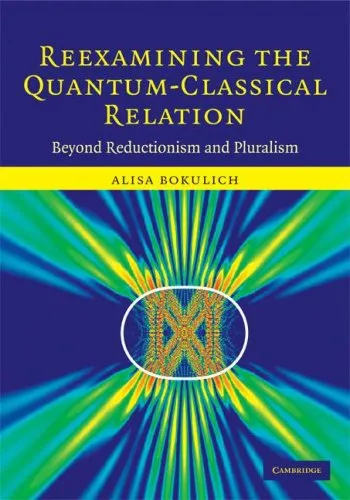
Reexamining the Quantum-Classical Relation: Beyond Reductionism and Pluralism
Alisa Bokulich
English
Beginner
Physics
4.3 / 5
0 reviews
2008
Published
206
pages
228
views
Introduction Welcome to Reexamining the Quantum-Classical Relation: Beyond Reductionism and Pluralism, a work that seeks to unravel the nuanced and intricate relationship between the classical and quantum domains of physics. Authored by Alisa Bokulich, this book
Before you read
What will you get from this book?
Introduction
Welcome to Reexamining the Quantum-Classical Relation: Beyond Reductionism and Pluralism, a work that seeks to unravel the nuanced and intricate relationship between the classical and quantum domains of physics. Authored by Alisa Bokulich, this book navigates a complex yet fascinating terrain, challenging entrenched views while proposing innovative frameworks to understand the layered nature of quantum mechanics and classical physics.
The traditional dichotomy between the quantum and the classical has often been framed through lenses of reductionism, which seeks to derive classical phenomena entirely from quantum laws, or pluralism, which maintains the autonomy and incommensurability of the two realms. However, this book goes beyond these paradigms, presenting fresh perspectives that dissolve the perceived boundaries between these domains. With robust philosophical insights and rich scientific examples, Bokulich constructs a bridge that fosters a more integrated understanding of physics.
A Detailed Summary of the Book
The central premise of the book lies in tackling the quantum-classical relation, an issue at the heart of philosophy of science and physics. Bokulich critiques the traditional reductionist approach, which posits that classical physics supervenes entirely on quantum principles, effectively reducing the former to a mere approximation. Simultaneously, she questions the pluralist perspective, which holds that classical and quantum mechanics are entirely disjointed frameworks with no overlapping coherence.
Bokulich introduces a middle ground that she terms the "interactive model." This framework emphasizes the mutual influence and interdependence of the classical and quantum traditions in physical explanations. Through this lens, she explores various cases in modern physics, such as the role of semiclassical mechanics, the utilization of classical visualizations in quantum explanations, and the mathematical structures that tie quantum and classical physics together. Bokulich argues that both classical and quantum systems interact in ways that resist easy compartmentalization, challenging simplified views of either reduction or incommensurability.
Throughout the book, Bokulich also dives into the philosophical implications of these insights. She reexamines traditional metaphysical commitments that elevate either quantum mechanics as the fundamental truth of physics or classical mechanics as a relic of a bygone era. Instead, she advocates for a richer, layered conception of science as a coherent enterprise that incorporates multiple explanatory levels.
Key Takeaways
- Reductionism and pluralism fail to capture the intricate relationship between classical and quantum physics.
- The interactive model offers a novel framework for understanding the interdependence between classical and quantum mechanics.
- Classical tools and intuitions remain essential in certain areas of quantum mechanical explanation.
- The boundary between classical and quantum systems should not be viewed as rigid but rather as context-dependent and interactive.
- Philosophically, science benefits from a pluralistic yet integrated approach to theoretical frameworks.
Famous Quotes from the Book
"Rather than attempting to dissolve the classical into the quantum or dismissing one as less fundamental, we must recognize their mutual contributions to the enterprise of physical explanation."
"The interplay between classical and quantum mechanics is not a sign of disunity in physics but rather an illustration of the layered complexity inherent in the physical world."
"Semiclassical mechanics stands as a testament to the fruitfulness of hybrid theories that draw strength from both quantum and classical domains."
Why This Book Matters
This book holds particular relevance for philosophers of science, physicists, and interdisciplinary scholars who are interested in the foundational aspects of scientific theory. By transcending the entrenched dichotomies of reductionism and pluralism, Bokulich offers a dynamic and integrative perspective that has profound implications for our understanding of the physical universe.
In addition to its academic significance, the book provides readers with an accessible guide to key issues in contemporary physics, such as mathematical modeling, interpretation of quantum mechanics, and the evolution of physical theories. Its arguments invite readers to reevaluate long-held assumptions while appreciating the nuance and depth of the quantum-classical dialogue. This work is a call to embrace complexity and interdependence, recognizing the scientific endeavor as a tapestry woven with many threads rather than a hierarchy of isolated truths.
Ask this book
Your question is answered in the context of this title and author. Each answer uses 2 points.
Sign in to ask the book assistant.
Reader reviews
0 reviews, 4.3 average out of 5
No reviews yet
If you have read this book, help the next reader with your experience.
Write a review
Sign in to publish a review.
Reader questions and answers
Ask a focused question and learn from the community.
Sign in to ask or answer a question.
No questions yet
Be the first to ask a clear, useful question.
What to read next
Related references that continue this learning path.


Modern Computer Vision with PyTorch: A Practical Roadmap From Deep Learning Fundamentals to Advanced Applications and Generative AI, 2nd Edition
V Kishore Ayyadevara,Yeshwanth Reddy
2023
View book