
Foundations of Relational Realism-A topological approach to quantum mechanics and the philosophy of nature
Michael Epperson,Elias Zafiris
2013
View book
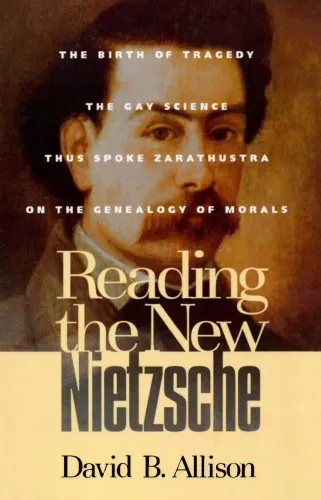
Book guide and evaluation
David B. Allison
0 reviews
Published
pages
views
Introduction Welcome to the profound world of Friedrich Nietzsche, one of the most influential philosophers in Western thought, whose writings continue to provoke and inspire deep reflection on life, morality, and the human condition. "Reading the New Nietzsche: The Birth
Before you read
Welcome to the profound world of Friedrich Nietzsche, one of the most influential philosophers in Western thought, whose writings continue to provoke and inspire deep reflection on life, morality, and the human condition. "Reading the New Nietzsche: The Birth of Tragedy, The Gay Science, Thus Spoke Zarathustra, and On the Genealogy of Morals" delves into four of Nietzsche’s seminal works, offering insights that are as thought-provoking today as when they were first penned.
The book begins with a thorough analysis of "The Birth of Tragedy," where Nietzsche explores the dichotomy of the Apollonian and Dionysian principles in art and life. This section unravels Nietzsche's early ideas on aesthetics and the role of art in shaping culture and human experience.
Next, "The Gay Science" is examined, where Nietzsche famously declares, "God is dead." Here, the text delves into themes of existentialism, nihilism, and the joyous embrace of life free from traditional moral constraints. It’s a celebration of doubt and intellectual bravery, inviting readers to re-evaluate their values.
"Thus Spoke Zarathustra" is perhaps Nietzsche's most poetic and enigmatic work. This part of the book provides a deep dive into its philosophical allegories, particularly the idea of the Übermensch, or "overman," which challenges humankind to transcend traditional beliefs and limitations to create new values and meanings.
Lastly, "On the Genealogy of Morals" is dissected to explore Nietzsche's critique of traditional morality. This part offers an incisive discussion on how societal norms and religious doctrines have shaped human behavior and thought, advocating for a reevaluation of morality based on life-affirming principles.
"God is dead. God remains dead. And we have killed him."
"He who fights with monsters should be careful lest he thereby become a monster. And if you gaze long into an abyss, the abyss also gazes into you."
Nietzsche remains a pivotal figure in philosophy and literature, and "Reading the New Nietzsche" seeks to illuminate the intricacies of his thought for both newcomers and seasoned scholars. By breaking down complex themes and ideas into accessible analyses, this book enables a deeper appreciation of Nietzsche's enduring legacy.
Understanding Nietzsche is essential for anyone seeking to explore existentialist and postmodern thought, as his work laid the groundwork for future philosophical developments. This book also matters because it encourages readers to critically examine the constructs of society and to entertain radical thought as a means of achieving personal and intellectual liberation.
Ultimately, "Reading the New Nietzsche" is more than an academic exercise; it is an invitation to engage with life's profound questions and embrace the challenge of thinking beyond convention. It’s a book that prompts personal transformation and inspires the perpetual rediscovery and reinvention of self and society.
Your question is answered in the context of this title and author. Each answer uses 2 points.
0 reviews, 4.6 average out of 5
Sign in to publish a review.
Ask a focused question and learn from the community.
Related references that continue this learning path.
Michael Epperson,Elias Zafiris

Giancarlo Ghirardi;Gerald Malsbary