Book guide and evaluation
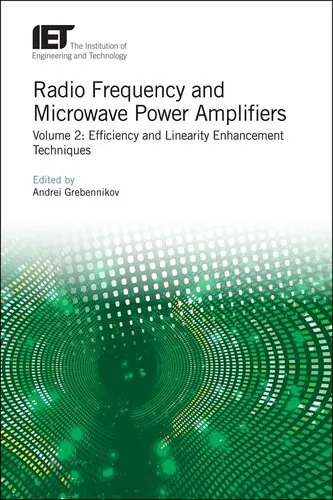
Radio Frequency and Microwave Power Amplifiers: Efficiency and Linearity Enhancement Techniques (Materials, Circuits and Devices)
Andrei Grebennikov (editor)
English
Beginner
Algebra
4.0 / 5
0 reviews
2019
Published
500
pages
476
views
Welcome to an exploration of the intricate world of radio frequency and microwave power amplifiers, where efficiency and linearity are not just technical specifications, but critical elements in the pursuit of advanced communication systems. This book, "Radio Frequency and Micr
Before you read
What will you get from this book?
Welcome to an exploration of the intricate world of radio frequency and microwave power amplifiers, where efficiency and linearity are not just technical specifications, but critical elements in the pursuit of advanced communication systems. This book, "Radio Frequency and Microwave Power Amplifiers: Efficiency and Linearity Enhancement Techniques," serves as a comprehensive guide for engineers, researchers, and students who are keen to deepen their understanding and mastery of this crucial field in electronic engineering.
Detailed Summary of the Book
The book delves deeply into the principles and practice of enhancing the efficiency and linearity of radio frequency (RF) and microwave power amplifiers. It systematically covers the essential concepts, materials, and circuit techniques necessary for designing amplifiers that meet the demanding requirements of modern communication technologies. The text is structured into several core sections, each focusing on different aspects of power amplifier design.
The initial chapters address the theoretical underpinnings of RF and microwave power amplifiers, providing the fundamental concepts and mathematical models that form the basis of this field. Following this foundation, the book explores the various types of power amplifiers, including Class A, B, C, D, E, F, and their subtypes, highlighting their respective advantages, disadvantages, and application scopes.
As the reader progresses, the focus shifts to advanced design techniques aimed at optimizing both efficiency and linearity. This includes discussions on load-pull techniques, envelope tracking, and digital predistortion. Moreover, the book examines the role of semiconductor materials, such as GaN and SiC, and their impact on amplifier performance.
Key Takeaways
- Understanding the critical balance between efficiency and linearity in amplifier performance.
- Comprehensive knowledge of different classes of power amplifiers and their operational principles.
- Practical insights into the use of materials and modern circuit techniques for amplifier enhancement.
- Technical guidance on implementing cutting-edge technologies such as digital predistortion and envelope tracking.
Famous Quotes from the Book
"In the world of RF engineering, power amplifiers are the heart that drives signal strength, and efficiency is the soul that energizes sustainability."
"Achieving the perfect balance between linearity and efficiency is much like a delicate dance, where one step off-beat can lead to a flawed execution."
Why This Book Matters
Radio frequency and microwave power amplifiers have become indispensable in the era of wireless communication, supporting a myriad of applications from cellular networks to satellite communications. The imperative to enhance efficiency and linearity is driven by the need to minimize power consumption, reduce operational costs, and improve signal integrity in increasingly congested frequency bands.
This book stands out as a valuable resource because it not only addresses the fundamental principles but also provides actionable strategies that engineers can apply in real-world scenarios. Its comprehensive approach caters to both novices in the field and seasoned professionals looking to stay abreast of the latest advancements and methodologies. By bridging the gap between theoretical knowledge and practical application, this book empowers its readers to contribute meaningfully to the field of RF and microwave engineering, driving forward technological innovation.
Ask this book
Your question is answered in the context of this title and author. Each answer uses 2 points.
Sign in to ask the book assistant.
Reader reviews
0 reviews, 4.0 average out of 5
No reviews yet
If you have read this book, help the next reader with your experience.
Write a review
Sign in to publish a review.
Reader questions and answers
Ask a focused question and learn from the community.
Sign in to ask or answer a question.
No questions yet
Be the first to ask a clear, useful question.
What to read next
Related references that continue this learning path.