
Joseph Tharwat
2025/09/17
5 / 5
it seams that it is a good book
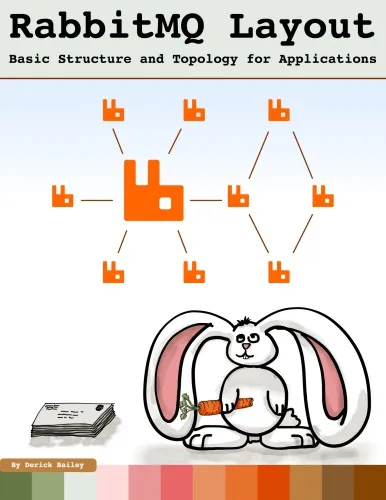
Book guide and evaluation
Derick Bailey
1 reviews
Published
pages
views
Welcome to a comprehensive guide on RabbitMQ, where we demystify its complex structure to help you build robust, scalable applications that take full advantage of its messaging capabilities. Summary In "RabbitMQ Layout: Basic Structure and Topology for A
Before you read
Welcome to a comprehensive guide on RabbitMQ, where we demystify its complex structure to help you build robust, scalable applications that take full advantage of its messaging capabilities.
In "RabbitMQ Layout: Basic Structure and Topology for Applications," I take you through the intricate world of RabbitMQ, an open-source message broker software that facilitates communication between distributed applications. This book is meticulously designed to cater to both beginners and seasoned developers who are eager to delve into the depths of RabbitMQ to build efficient, distributed systems.
The narrative is structured to swiftly move from foundational concepts to advanced deployment strategies. You will start by understanding message queue principles and RabbitMQ's role in delivering these. The technical intricacies of exchanges, queues, and bindings are elucidated with real-world analogies to solidify your comprehension. As the chapters progress, you will engage with more complex architectural strategies, focusing on designing topologies for tasks such as load balancing, message routing, and reliable delivery.
This book does more than just guide you through the technicalities; it integrates best practices and alternative approaches to help you build systems that are not only functional but also resilient and maintainable. You will gain insights into RabbitMQ's clustering and federation capabilities, learn to monitor RabbitMQ instances effectively, and explore use cases that demonstrate its application in various industries.
"RabbitMQ might be invisible to the end-user, but it’s the invisible thread that can stitch your chaotic microservices into a harmonious digital symphony."
"There is no single topology that fits all use cases in RabbitMQ. The art lies in tailoring a topology that acknowledges the uniqueness of each application."
In the rapidly evolving landscape of technology, applications are becoming more distributed and complex. Reliable communication between components is paramount, and RabbitMQ stands out as a leading solution for enabling this communication. However, mastering RabbitMQ requires more than basic knowledge; it demands an understanding of its underlying structures and how they can be aligned with application-specific requirements.
This book is significant because it empowers you as a developer to harness the full potential of RabbitMQ, equipping you with the knowledge to navigate common challenges and to foster the creation of resilient systems. Whether you are looking to integrate RabbitMQ into your existing infrastructure or to improve upon its current implementation, this book provides the depth and breadth necessary to elevate your skills and your systems.
Moreover, as RabbitMQ continues to evolve, staying updated with its best practices and emerging use cases is crucial for any modern application developer. This book ensures you keep pace with these developments, making it an invaluable resource in your technical library.
Your question is answered in the context of this title and author. Each answer uses 2 points.
1 reviews, 5.0 average out of 5
2025/09/17
5 / 5
it seams that it is a good book
Sign in to publish a review.
Ask a focused question and learn from the community.
Related references that continue this learning path.


E. Bick,F.D. Steffen (auth.),Eike Bick,Frank Daniel Steffen (eds.)

A. V. Arkhangel’skiǐ,V. V. Fedorchuk (auth.),A. V. Arkhangel’skii,L. S. Pontryagin (eds.)