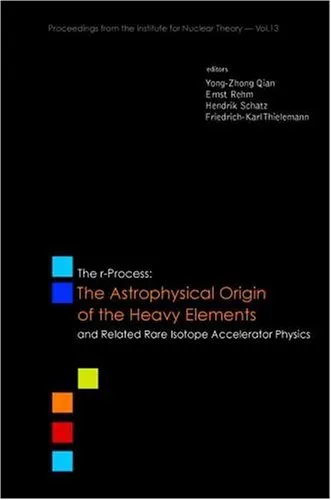
Introduction to "R-process: The Astrophysical Origin of the Heavy Elements and Related Rare Isotope Accelerator Physics"
"R-process: The Astrophysical Origin of the Heavy Elements and Related Rare Isotope Accelerator Physics" represents a crucial contribution to our understanding of astrophysical processes and their link to nuclear science. This book, derived from proceedings at the Institute for Nuclear Theory, offers an in-depth exploration of the rapid neutron capture process (r-process), which is fundamental to the creation of the universe's heaviest elements. As a comprehensive resource, it bridges the gap between theoretical astrophysics, experimental nuclear physics, and advanced applications in rare-isotope accelerator technology.
Written by a distinguished team of experts, Yong-Zhong Qian, Ernst Rehm, Hendrik Schatz, and Friedrich-Karl Thielemann, this volume addresses questions that have intrigued scientists for decades: How are heavy elements like gold, platinum, and uranium formed? Where do these processes occur in the universe? How can experimental advances improve our understanding of these cosmic enigmas? Through extensive discussions and findings, this book answers these pivotal questions with rigorous scientific detail while also presenting opportunities for future research.
Summary of the Book
The book provides a systematic approach to understanding the r-process, introducing readers to its astrophysical context and the critical role it plays in nucleosynthesis. It begins with an overview of nuclear astrophysics and delves into the sites of the r-process, such as supernovae and neutron star mergers, which serve as cosmic crucibles for heavy element formation. Addressing both theoretical and observational perspectives, the authors integrate recent discoveries and computational simulations to demonstrate how r-process nucleosynthesis unfolds in extreme astrophysical environments.
Furthermore, the book explores the intersection of nuclear physics and astrophysics. Topics such as nuclear reaction rates, rare isotope beam facilities, and experimental constraints on neutron-rich nuclei are presented with an emphasis on their application to r-process studies. Emerging technologies, such as next-generation rare isotope accelerators, are also discussed to highlight how modern advancements are revolutionizing our ability to simulate and study these phenomena.
Throughout its chapters, the book intertwines theoretical models with observational data, offering a detailed narrative of how elements heavier than iron are synthesized and distributed in the cosmos. It emphasizes the importance of collaboration between astrophysicists and nuclear physicists to further refine our understanding of elemental formation and its implications for the universe's evolution.
Key Takeaways
- The r-process is essential for creating approximately half of the heavy elements in the periodic table, including gold, thorium, and uranium.
- Astrophysical sites, such as neutron star mergers and certain supernovae, are the primary settings for r-process nucleosynthesis.
- Rare isotope accelerators, like those in development, can simulate the extreme conditions where r-process elements are formed.
- Collaborative efforts between observational astrophysics and nuclear physics are vital for advancing our knowledge of the cosmos.
- Future experimental and technological innovations will enable more accurate mapping of the nuclear landscape involved in the r-process.
Famous Quotes from the Book
"The origin of heavy elements is not merely a cosmic mystery—it is a story of extreme environments, where physics and astrophysics converge to shape the fabric of our universe."
"The r-process reveals how the universe creates out of chaos, forming the building blocks for planets, stars, and ultimately, life itself."
Why This Book Matters
The significance of "R-process: The Astrophysical Origin of the Heavy Elements" extends beyond its academic scope. By addressing one of the cosmos's most enduring questions—the origins of the heaviest elements—this book serves as a cornerstone for interdisciplinary research. It is a vital resource for astrophysicists, nuclear physicists, and students aiming to understand how the universe has evolved to produce the elements essential for life and the physical world we observe today.
Its emphasis on experimental advancements, particularly in rare-isotope accelerator technology, positions the book as a forward-thinking work that not only consolidates current knowledge but also sets the stage for groundbreaking discoveries. In the age of multimessenger astronomy, where gravitational waves and electromagnetic signals reveal new insights into cosmic events, the study of r-process nucleosynthesis is more pertinent than ever. This book empowers readers to appreciate the interconnectedness of fundamental physics, cutting-edge technology, and the mysteries of the universe.
Ultimately, "R-process: The Astrophysical Origin of the Heavy Elements" is a testament to human curiosity and our relentless pursuit of knowledge about the cosmos. It challenges readers to think beyond traditional disciplinary boundaries and inspires the next generation of researchers to unravel the intricacies of the universe.