Loading
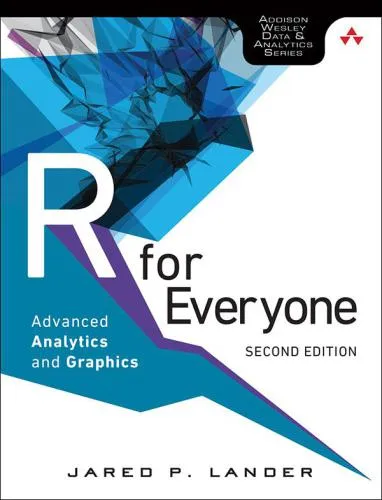
Cover of R for Everyone: Advanced Analytics and Graphics

Book guide and evaluation

R for Everyone: Advanced Analytics and Graphics

Jared P. Lander

English Beginner Artificial Intelligence (AI)
4.6 / 5

0 reviews

2017

Published

559

pages

516

views

Using the open source R language, you can build powerful statistical models to answer many of your most challenging questions. R has traditionally been difficult for non-statisticians to learn, and most R books assume far too much knowledge to be of help. R for Everyone, Second E

Before you read

What will you get from this book?

Using the open source R language, you can build powerful statistical models to answer many of your most challenging questions. R has traditionally been difficult for non-statisticians to learn, and most R books assume far too much knowledge to be of help. R for Everyone, Second Edition, is the solution. Drawing on his unsurpassed experience teaching new users, professional data scientist Jared P. Lander has written the perfect tutorial for anyone new to statistical programming and modeling. Organized to make learning easy and intuitive, this guide focuses on the 20 percent of R functionality you'll need to accomplish 80 percent of modern data tasks. Lander's self-contained chapters start with the absolute basics, offering extensive hands-on practice and sample code. You'll download and install R; navigate and use the R environment; master basic program control, data import, manipulation, and visualization; and walk through several essential tests. Then, building on this foundation, you'll construct several complete models, both linear and nonlinear, and use some data mining techniques. After all this you'll make your code reproducible with LaTeX, RMarkdown, and Shiny. By the time you're done, you won't just know how to write R programs, you'll be ready to tackle the statistical problems you care about most. Coverage includes: - Explore R, RStudio, and R packages - Use R for math: variable types, vectors, calling functions, and more - Exploit data structures, including data.frames, matrices, and lists - Read many different types of data - Create attractive, intuitive statistical graphics - Write user-defined functions - Control program flow with if, ifelse, and complex checks - Improve program efficiency with group manipulations - Combine and reshape multiple datasets - Manipulate strings using R™s facilities and regular expressions - Create normal, binomial, and Poisson probability distributions - Build linear, generalized linear, and nonlinear models - Program basic statistics: mean, standard deviation, and t-tests - Train machine learning models - Assess the quality of models and variable selection - Prevent overfitting and perform variable selection, using the Elastic Net and Bayesian methods - Analyze univariate and multivariate time series data - Group data via K-means and hierarchical clustering - Prepare reports, slideshows, and web pages with knitr - Display interactive data with RMarkdown and htmlwidgets - Implement dashboards with Shiny - Build reusable R packages with devtools and Rcpp

Ask this book

Your question is answered in the context of this title and author. Each answer uses 2 points.

Sign in to ask the book assistant.

Reader reviews

0 reviews, 4.6 average out of 5

No reviews yet

If you have read this book, help the next reader with your experience.

Write a review

Sign in to publish a review.

Reader questions and answers

Ask a focused question and learn from the community.

Sign in to ask or answer a question.

No questions yet

Be the first to ask a clear, useful question.