
Introduction to the Theory of Quantum Information Processing
János A. Bergou,Mark Hillery (auth.)
2013
View book
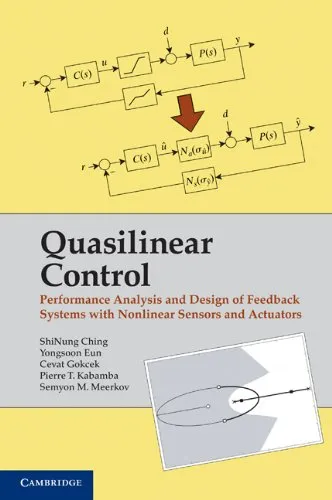
Book guide and evaluation
ShiNung Ching; et al
0 reviews
Published
pages
views
Welcome to the introduction to 'Quasilinear Control: Performance Analysis and Design of Feedback Systems with Nonlinear Sensors and Actuators'. This in-depth work explores a cutting-edge realm of control theory that bridges the complexities of nonlinear sy
Before you read
Welcome to the introduction to 'Quasilinear Control: Performance Analysis and Design of Feedback Systems with Nonlinear Sensors and Actuators'. This in-depth work explores a cutting-edge realm of control theory that bridges the complexities of nonlinear systems and the analytical framework of linear control. Designed for researchers, engineers, and advanced students, this book guides readers through theoretical foundations, practical methods, and innovative perspectives on modern feedback systems. Rich in rigor and application, it empowers you to understand, analyze, and design quasilinear systems with ease and efficiency. Below, you’ll find a detailed exploration of what the book offers and why it’s a must-read in contemporary control systems.
The book extensively addresses quasilinear control system design, a nuanced domain that considers the interplay between nonlinear components (such as sensors and actuators) and traditional linear control theory. Early chapters introduce the foundational mathematical tools and frameworks needed to approach quasilinear systems, including modeling of feedback systems, frequency domain techniques, and stability analysis. Midway, the text transitions into a detailed examination of performance metrics, offering insights into robustness, gain margins, and phase margins under quasilinear conditions. A prominent portion of the book is dedicated to system performance optimization, focusing on adapting control structures to meet real-world nonlinearities.
What sets this book apart is its dual-pronged approach: theoretical investigation paired with computational tools. By leveraging analytical methods like harmonic balance and state-space models, readers not only understand system dynamics but also gain the ability to predict and mitigate adverse behaviors. Furthermore, case studies enrich the theoretical discussions, providing concrete examples of the challenges and triumphs in designing nonlinear systems for aerospace, robotics, and industrial automation.
Through this book, readers are equipped with a comprehensive toolbox to model, analyze, and design feedback systems that integrate nonlinear components within a structured, scientifically grounded framework.
"The essence of quasilinear system design lies in understanding the nonlinearity, not as an obstacle, but as an integral component of performance enhancement."
"A truly robust control system does not remove nonlinearity; it harmonizes with it."
In an era dominated by complex systems that rely heavily on advanced sensors and actuators, understanding nonlinearities within feedback loops has become a critical competency for engineers and researchers alike. The classical control theory, while powerful, struggles when applied to systems with pronounced nonlinearity. This book fills that gap by providing a clear and focused framework for handling those nonlinear elements through quasilinear techniques.
More importantly, this book is not just about theory—it’s about empowering the reader to innovate. By viewing nonlinearity as an opportunity instead of a limitation, this work paves the way for groundbreaking advancements in fields such as autonomous systems, medical devices, and energy-efficient technologies.
The text is meticulously written, blending mathematical rigor with practical insights. For anyone passionate about control theory and its applications, this book serves as both a guide and a source of inspiration. It challenges conventional thought while providing the tools to reimagine what’s possible in modern control systems.
Your question is answered in the context of this title and author. Each answer uses 2 points.
0 reviews, 4.5 average out of 5
Sign in to publish a review.
Ask a focused question and learn from the community.
Related references that continue this learning path.
János A. Bergou,Mark Hillery (auth.)
Alexandre M. Zagoskin
Willem Hendrik Dickhoff,Dimitri Van Neck