
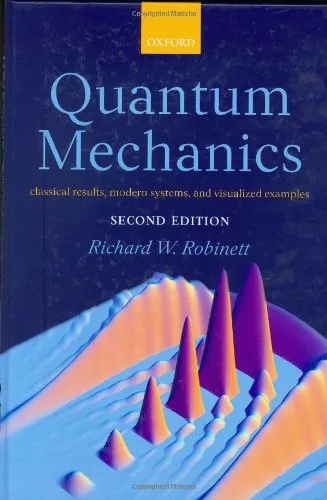
Quantum mechanics: classical results, modern systems, and visualized examples
Richard Robinett
2006
View book
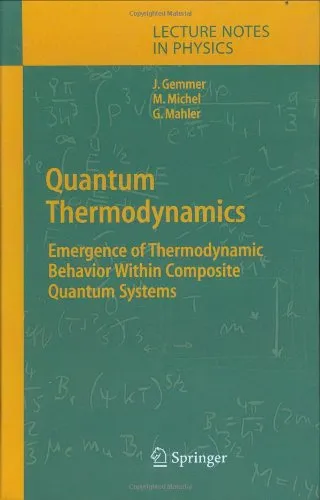
Book guide and evaluation
J. Gemmer,M. Michel,G. Mahler (auth.)
0 reviews
Published
pages
views
Introduction to "Quantum Thermodynamics: Emergence of Thermodynamic Behavior Within Composite Quantum Systems" Quantum thermodynamics is a cutting-edge field that bridges the gap between the quantum world and classical thermodynamics. The book "Quantum Thermodynami
Before you read
Quantum thermodynamics is a cutting-edge field that bridges the gap between the quantum world and classical thermodynamics. The book "Quantum Thermodynamics: Emergence of Thermodynamic Behavior Within Composite Quantum Systems" explores the fundamental principles behind this fascinating intersection. Written by J. Gemmer, M. Michel, and G. Mahler, this book offers a comprehensive exploration of how thermodynamic behavior emerges from quantum mechanical systems, delving into both theoretical underpinnings and practical implications.
As the foundations of thermodynamics are deeply rooted in classical physics, the transition to quantum thermodynamics represents one of the most revolutionary shifts in how we understand energy, information, and entropy. This book methodically addresses key questions: What is the thermodynamic behavior of quantum systems? How does irreversibility emerge from reversible quantum processes? And finally, how do we reconcile classical thermodynamic laws with the probabilistic nature of quantum mechanics?
By combining traditional thermodynamic principles with cutting-edge quantum models and interactions, the authors provide a fresh perspective on thermalization, entropy production, and energy transfer in composite systems. With a balance of theoretical depth and mathematical rigor, this book is an essential read for physicists, graduate students, and interdisciplinary researchers drawn to the complexities of quantum systems.
This book methodically unravels thermodynamic behavior in quantum systems, starting with classical thermodynamics and gradually transitioning to quantum principles. It begins with a primer on thermodynamic concepts such as entropy, temperature, and the second law of thermodynamics, emphasizing their classical formulations. From there, it transitions into quantum mechanics, exploring the dynamics of open quantum systems and their interactions with environments or reservoirs.
At the heart of the book lies the concept of thermalization, which examines how isolated quantum systems evolve toward equilibrium states. The authors analyze statistical ensembles, providing a comprehensive view of how macroscopic thermodynamic laws can emerge from microscopic quantum rules. Various models, including spin chains and harmonic systems, demonstrate real-world scenarios, offering accessible insights into energy transfer, decoherence, and entropy production.
The book also explores phenomena such as the quantum-to-classical transition, the role of measurement-induced irreversibility, and non-equilibrium dynamics. It takes a deeper dive into the structure of quantum entanglement and its connection to thermodynamic properties, addressing key issues such as resource consumption, energy efficiency, and the interplay between coherence and dissipation in quantum engines. Through insightful examples and concrete mathematical derivations, the authors reveal how quantum statistics play an integral role in understanding advanced thermodynamic phenomena.
"Thermodynamic behavior is not an inherent feature of nature. Rather, it arises as an emergent property of statistical interactions within composite systems."
"Entropy, often synonymous with disorder, can instead be framed in terms of the quantum mechanical probability landscape of fluctuating macrostates."
"We find that quantum coherence, rather than contradicting thermodynamic principles, enriches our understanding of far-from-equilibrium systems."
"Quantum Thermodynamics: Emergence of Thermodynamic Behavior Within Composite Quantum Systems" stands as a landmark contribution to the scientific community. As quantum technologies advance rapidly, understanding their thermodynamic limits and possibilities becomes increasingly critical. This book not only lays the theoretical groundwork for researchers but also provides insight into practical applications such as energy-efficient quantum computing and nanoscale engines.
Moreover, the book's emphasis on the emergence of classical laws from quantum principles speaks to one of the biggest challenges in modern physics: unifying our understanding of the macroscopic and microscopic worlds. For students and professionals alike, the clarity and precision with which the authors handle these complex topics make the content accessible while maintaining scientific rigor.
This work is critically important for those exploring quantum systems, thermodynamics, and statistical mechanics, as it serves as a bridge between disciplines. By emphasizing emergent phenomena and shedding light on the interplay of information, energy, and entropy, this book shows how quantum technologies may ultimately enhance our understanding of the universe.
Your question is answered in the context of this title and author. Each answer uses 2 points.
0 reviews, 4.5 average out of 5
Sign in to publish a review.
Ask a focused question and learn from the community.
Related references that continue this learning path.
Richard Robinett

Çengel,Yunus A. Boles,Michael A. Kanoğlu,Mehmet