Lectures on Quantum Mechanics: With Problems, Exercises and their Solutions
Jean-Louis Basdevant
2016
View book
Book guide and evaluation
Alexander L. Fetter,John Dirk Walecka,Physics
0 reviews
Published
pages
views
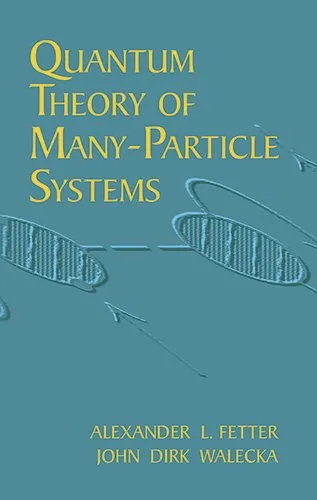
Introduction to Quantum Theory of Many-Particle Systems Written by Alexander L. Fetter and John Dirk Walecka, Quantum Theory of Many-Particle Systems is a seminal text in the fields of quantum mechanics and condensed matter physics. This book has carved a
Before you read
Written by Alexander L. Fetter and John Dirk Walecka, Quantum Theory of Many-Particle Systems is a seminal text in the fields of quantum mechanics and condensed matter physics. This book has carved a niche as one of the most comprehensive resources for understanding the intricate behavior of many-particle systems on a quantum mechanical level. It offers a balance of theoretical rigor and practical methodologies, serving as a valuable guide for both students and professionals. By emphasizing the interplay between physics, mathematics, and application, the book remains a cornerstone for those looking to delve into the world of quantum many-body systems.
The content explores advanced quantum mechanical theories, focusing on their application to systems composed of many interacting particles. With its logical progression and depth, the book empowers readers to grasp key concepts, master computational techniques, and develop the ability to investigate new challenges in the physics of many-body problems. Its widespread use in academic settings has elevated it to a classic textbook for those pursuing graduate studies or advanced research in quantum mechanics, statistical mechanics, and condensed matter theory.
Quantum Theory of Many-Particle Systems begins by introducing the foundational principles of many-particle quantum systems, with particular emphasis on their distinguishing features compared to single-particle systems. The book systematically presents field-theoretic methods, emphasizing their application to particles interacting through various force potentials. Topics such as second quantization, Green’s functions, and perturbation theory are explored extensively.
The text covers not only fermionic and bosonic systems but also delves into experimental phenomena such as superfluidity, superconductivity, and magnetism, connecting theory with observed physical reality. Readers are guided through concepts like Fermi liquids, Bose-Einstein condensates, and the quasiparticle framework, providing a cohesive understanding of emergent behaviors in many-body systems.
Advanced sections tackle the mathematics underpinning quantum field theory and statistical mechanics, equipping readers with the tools needed to solve real-world problems. The authors' clear expository style and emphasis on physical insight, coupled with derivations of key equations, distinguish the book as an authoritative text that bridges theory and practice.
The book contains numerous passages that encapsulate the elegance and complexity of many-particle physics. Here are a few notable quotes:
"Many-particle quantum theory is not just an extension of single-particle ideas; it is a foundational framework for understanding the collective behavior of quantum systems."
"In many ways, the notion of quasiparticles allows us to reconcile the seeming chaos of many-body systems with the clarity of single-particle frameworks."
"The goal of quantum field theory is to provide a consistent language for describing systems where individual particles lose their identities, giving rise to new collective modes of behavior."
Quantum Theory of Many-Particle Systems holds a unique place in the world of physics literature. Its methodical approach and focus on fundamental principles make it an essential resource for physicists and mathematicians alike. The book's relevance has only grown over time, particularly as quantum-based technologies such as quantum computing and quantum simulation become more prominent. A deep understanding of many-body systems is fundamental to advancing these fields.
Furthermore, Fetter and Walecka's treatment of the subject not only enhances theoretical competence but also encourages exploration of the interplay between quantum mechanics and emergent phenomena. Whether you're a student new to the field or an experienced researcher, this book provides the clarity and tools necessary to push the boundaries of innovation in many-particle quantum physics.
Your question is answered in the context of this title and author. Each answer uses 2 points.
0 reviews, 4.5 average out of 5
Sign in to publish a review.
Ask a focused question and learn from the community.
Related references that continue this learning path.
Jean-Louis Basdevant

Arnold F. Nikiforov,Vladimir G. Novikov,V.B. Uvarov (auth.)