

Book guide and evaluation
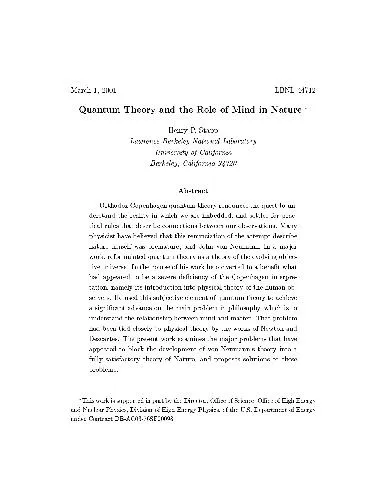
Quantum theory and the role of mind in nature
Stapp H.P.
English
Beginner
Art
4.9 / 5
0 reviews
2001
Published
42
pages
131
views
Introduction to "Quantum Theory and the Role of Mind in Nature" "Quantum Theory and the Role of Mind in Nature" delves into one of the most intriguing intersections of human inquiry: the nexus of quantum theory, consciousness, and the fundamental understanding of our univers
Before you read
What will you get from this book?
Introduction to "Quantum Theory and the Role of Mind in Nature"
"Quantum Theory and the Role of Mind in Nature" delves into one of the most intriguing intersections of human inquiry: the nexus of quantum theory, consciousness, and the fundamental understanding of our universe. Written with clarity and precision, this book explores how quantum physics reshapes our comprehension of reality and demonstrates the profound influence of the human mind in shaping the phenomena we observe.
Drawing upon the revolutionary insights of quantum mechanics, the book challenges traditional notions of a detached, objective reality. It pushes readers to consider a more participatory understanding of the universe, where the mind plays an essential role. Through an in-depth exploration of quantum theory, philosophical perspectives, and scientific breakthroughs, this work brings us face-to-face with the profound complexities of nature, directly implicating the role of human consciousness in shaping what we know and perceive.
Detailed Summary of the Book
The book begins by tracing the roots of quantum theory and its departure from classical, deterministic models of physics. Early quantum pioneers, such as Max Planck, Albert Einstein, and Niels Bohr, discovered anomalies in the behavior of microscopic particles—anomalies that could not be explained using traditional physical laws. These breakthroughs led to the emergence of quantum mechanics, a framework that describes the physical properties of nature at the smallest scales.
One of the central tenets of the book is how quantum mechanics introduces a unique feature: the role of the observer. Unlike classical physics, where the universe is depicted as an independent machine running on its own, quantum mechanics suggests that the act of observation impacts the state of a quantum system. This phenomenon is most famously illustrated through the "double-slit experiment" and the concept of wavefunction collapse.
As the narrative unfolds, the book dives deep into the philosophical implications of this observer-dependent reality. It addresses questions such as: Does the universe exist independently of consciousness? What is the nature of "mind" in the context of physical laws? Could consciousness be an integral component of the universe, rather than an accidental byproduct?
The book also draws on John von Neumann's mathematical formulations, which place consciousness at the heart of quantum measurement. Through this lens, the human mind is presented not merely as a passive observer but as an active participant in the unfolding of physical events. The work contemplates the potential interconnectedness of all minds, the enigmatic nature of free will, and the radical possibilities opened by quantum entanglement.
Ultimately, "Quantum Theory and the Role of Mind in Nature" expands the boundaries of science and philosophy, inviting readers to reevaluate their understanding of reality, consciousness, and the role humanity plays in the cosmic order.
Key Takeaways
- The role of the observer is central to understanding quantum phenomena, breaking the illusion of independent, objective reality.
- Consciousness is not merely a passive agent but may actively influence the outcomes of physical systems.
- Quantum mechanics provides a scientific framework to bridge the gap between physical reality and the subjective experience of the mind.
- Free will, interconnectedness, and the potential unification of science and philosophy are critical themes interwoven throughout the book.
- This work prompts a reevaluation of traditional materialist assumptions in light of revolutionary quantum discoveries.
Famous Quotes from the Book
"The observer is no longer a detached spectator but an integral part of the system being observed."
"Consciousness and the physical world are not separate entities; they coalesce to create the wholeness of reality."
"Quantum theory has shown us that the world is far stranger and more interconnected than we ever imagined."
Why This Book Matters
"Quantum Theory and the Role of Mind in Nature" is not just a book about science; it is a profound inquiry into the nature of existence and humanity's place in the cosmos. In an era where scientific materialism often dominates the discourse, this book provides a compelling counterpoint, arguing for a more integrated understanding of consciousness and reality. By addressing deep philosophical questions through the lens of rigorous quantum science, it bridges the gap between physics and metaphysical inquiry.
This work matters because it challenges us to rethink long-held assumptions about the nature of the world and our role within it. Its revolutionary ideas have the potential to influence fields ranging from neuroscience and psychology to cosmology and spiritual philosophy. For anyone interested in the big questions—about life, reality, and consciousness—this book offers an essential and transformative exploration.
Ask this book
Your question is answered in the context of this title and author. Each answer uses 2 points.
Sign in to ask the book assistant.
Reader reviews
0 reviews, 4.9 average out of 5
No reviews yet
If you have read this book, help the next reader with your experience.
Write a review
Sign in to publish a review.
Reader questions and answers
Ask a focused question and learn from the community.
Sign in to ask or answer a question.
No questions yet
Be the first to ask a clear, useful question.
What to read next
Related references that continue this learning path.


Modern Computer Vision with PyTorch: A Practical Roadmap From Deep Learning Fundamentals to Advanced Applications and Generative AI, 2nd Edition
V Kishore Ayyadevara,Yeshwanth Reddy
2023
View book