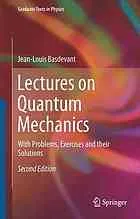
Lectures on Quantum Mechanics: With Problems, Exercises and their Solutions
Jean-Louis Basdevant
2016
View book
Book guide and evaluation
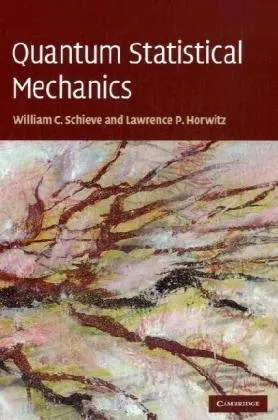
William C. Schieve,Lawrence P. Horwitz
0 reviews
Published
pages
views
Introduction to Quantum Statistical Mechanics "Quantum Statistical Mechanics" written by William C. Schieve and Lawrence P. Horwitz is an authoritative and comprehensive work that delves deeply into the interplay between quantum theory and statistic
Before you read
"Quantum Statistical Mechanics" written by William C. Schieve and Lawrence P. Horwitz is an authoritative and comprehensive work that delves deeply into the interplay between quantum theory and statistical mechanics. This book presents a thorough exploration of fundamental principles alongside advanced topics, making it an essential resource for researchers, academics, and students in physics, mathematics, and related fields.
By bridging the gap between classical statistical mechanics and quantum theory, this text offers profound insights into the statistical behavior of quantum systems. Emphasizing both theoretical rigor and practical applications, it examines systems of many particles, explores advanced quantum statistical frameworks, and provides a detailed analysis of non-equilibrium phenomena. With clarity and precision, Schieve and Horwitz present innovative approaches and methodologies aimed at expanding the understanding of quantum mechanics on a statistical basis.
Whether you are a student diving into the subject for the first time or a seasoned researcher seeking an in-depth resource, this book addresses foundational concepts as well as cutting-edge developments. The authors blend thorough mathematical descriptions with physical intuition, ensuring that readers at all levels can engage with the material effectively.
The book begins with a thoughtful examination of classical statistical mechanics, setting the stage for the introduction of quantum principles. It then transitions into quantum statistical mechanics by addressing the differences and synergies between the classical and quantum paradigms. Core topics include the derivation and application of quantum ensembles, the role of density matrices, and the treatment of indistinguishable particles. Special attention is given to the Bose-Einstein and Fermi-Dirac statistics, which underlie the behavior of bosons and fermions respectively.
Moving to more advanced topics, the text introduces non-equilibrium quantum statistical mechanics and explores the Markovian processes, master equations, and dynamical systems governing the real-time evolution of quantum systems. Furthermore, the book meticulously addresses quantum thermodynamics, providing in-depth discussions on entropy, information theory, and their implications within quantum contexts.
A distinguishing feature of the book is its application-oriented treatment. Real-world examples ranging from condensed matter physics to quantum optics are integrated into theoretical discussions to demonstrate the utility of quantum statistical mechanics in interpreting experimental data and solving practical problems. Each chapter is supplemented with mathematical appendices and exercises to reinforce the concepts presented.
In an era where quantum mechanics is transitioning from theoretical novelty to practical technology, "Quantum Statistical Mechanics" provides a crucial foundation for understanding the physics underlying quantum systems. It is vital for the study of fields like quantum computing, nanotechnology, and modern thermodynamics, where quantum statistical frameworks are increasingly important.
This book stands out for its exceptional blend of theoretical rigor and practical relevance. The authors do not merely present formulas and derivations. Instead, they offer a narrative that ties mathematics to deeply insightful physical interpretations. As quantum technology advances, the need to understand systems at both microscopic and macroscopic levels grows. This text not only educates but inspires readers to contribute to the expanding frontier of quantum science.
Ultimately, "Quantum Statistical Mechanics" is more than a textbook—it's a portal into the profound and intricate world of quantum systems, indispensable for anyone seeking a deeper understanding of the universe at its most fundamental level.
Your question is answered in the context of this title and author. Each answer uses 2 points.
0 reviews, 4.0 average out of 5
Sign in to publish a review.
Ask a focused question and learn from the community.
Related references that continue this learning path.
Jean-Louis Basdevant
Arnold F. Nikiforov,Vladimir G. Novikov,V.B. Uvarov (auth.)