

Book guide and evaluation
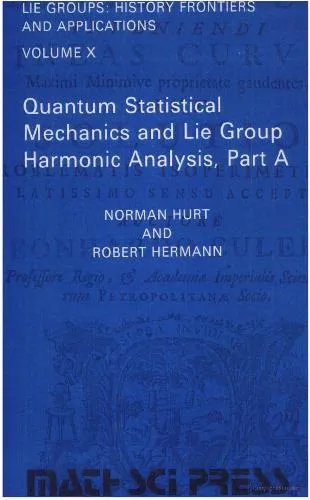
Quantum statistical mechanics and Lie group harmonic analysis
Norman Hurt,Robert Hermann
English
Beginner
Algebra
3.7 / 5
0 reviews
1980
Published
260
pages
243
views
Introduction to 'Quantum Statistical Mechanics and Lie Group Harmonic Analysis' "Quantum Statistical Mechanics and Lie Group Harmonic Analysis" explores the fascinating intersection of quantum physics, mathematics, and statistical methods, unraveling the complexities of
Before you read
What will you get from this book?
Introduction to 'Quantum Statistical Mechanics and Lie Group Harmonic Analysis'
"Quantum Statistical Mechanics and Lie Group Harmonic Analysis" explores the fascinating intersection of quantum physics, mathematics, and statistical methods, unraveling the complexities of quantum mechanics through the lens of Lie group theory and harmonic analysis. This book serves as a comprehensive resource for scholars and researchers seeking to navigate the subtle structures underlying modern physics while engaging with advanced mathematical tools.
Authored by Norman Hurt and Robert Hermann, this work delves deep into the mathematical frameworks that have emerged as foundational for understanding quantum systems and their statistical behaviors. By bridging the gap between abstract theory and real-world applications, the book caters to those aiming to both expand their theoretical knowledge and solve practical problems in quantum mechanics.
Detailed Summary of the Book
The book begins by laying the groundwork in quantum statistical mechanics, introducing readers to the fundamental principles that govern quantum systems and their thermodynamic behaviors. It emphasizes the natural evolution of statistical mechanics from classical perspectives to its quantum interpretation, detailing the dynamic changes when transitioning to systems that obey quantum rules.
A major focus is placed on Lie groups and their representations, as these mathematical structures provide elegant ways to describe symmetries in physical systems. Throughout the book, the authors guide readers through a structured progression of concepts such as group theory foundations, harmonic analysis, and their applications to quantum systems.
One of the central themes is the way quantum systems obey statistical laws that can be understood through harmonic analysis. The book explores how mathematical operators interact with Lie algebras and how these intricate relationships can be used to extract meaningful physical insights. It also provides an in-depth discussion of key techniques like spectral decomposition, spherical harmonics, and unique problem-solving strategies in quantum contexts.
For the applied scientist, this work is rich with illustrative examples drawn from quantum field theory, condensed matter physics, and statistical modeling in quantum systems. The book also contains detailed derivations, proofs, and thought-provoking exercises to strengthen the reader's understanding.
Key Takeaways
- A clear and systematic introduction to the mathematical methods underpinning quantum statistical mechanics.
- Insights into the symmetry properties of quantum systems, explored using Lie groups and harmonic analysis.
- Practical applications of mathematical techniques to solve advanced problems in quantum mechanics.
- An integration of abstract algebraic tools like Lie algebras into the realm of physics and quantum theory.
- A multidisciplinary approach that combines rigorous mathematics with intuitive physical insights.
Famous Quotes from the Book
"The true harmony of quantum mechanics lies in its symmetries, where mathematics takes form to describe nature itself."
"In the interplay between Lie group representations and quantum phenomena, we find the bridge between abstraction and reality."
Why This Book Matters
"Quantum Statistical Mechanics and Lie Group Harmonic Analysis" stands as an essential text for anyone pursuing advanced studies in physics or mathematics. Its unique focus on Lie theory as a tool for understanding quantum systems fills a critical gap in the literature. By tying symmetries in physics directly to mathematical representations, the book provides a new perspective on fundamental questions across disciplines.
Beyond its theoretical contributions, the book's structured approach and numerous applications make it a vital resource for aspiring researchers and seasoned professionals alike. At a time when quantum mechanics continues to reshape our understanding of the universe, this book offers the tools necessary to navigate its complexities with greater clarity and precision.
For educators, students, and practitioners, the insights and methods presented here will remain relevant for decades, reflecting the timeless nature of the deep connection between mathematics and the physical world.
Ask this book
Your question is answered in the context of this title and author. Each answer uses 2 points.
Sign in to ask the book assistant.
Reader reviews
0 reviews, 3.7 average out of 5
No reviews yet
If you have read this book, help the next reader with your experience.
Write a review
Sign in to publish a review.
Reader questions and answers
Ask a focused question and learn from the community.
Sign in to ask or answer a question.
No questions yet
Be the first to ask a clear, useful question.
What to read next
Related references that continue this learning path.


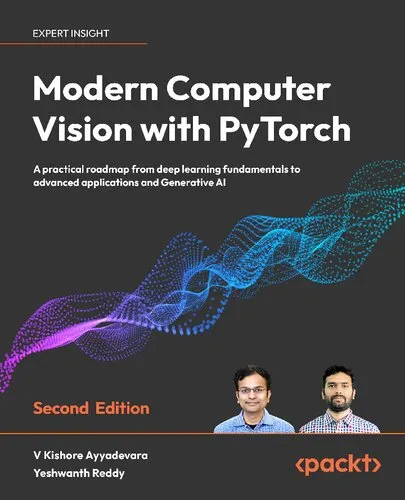
Modern Computer Vision with PyTorch: A Practical Roadmap From Deep Learning Fundamentals to Advanced Applications and Generative AI, 2nd Edition
V Kishore Ayyadevara,Yeshwanth Reddy
2023
View book