

Book guide and evaluation
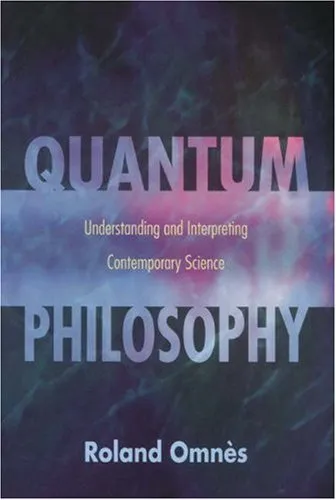
Quantum philosophy: understanding and interpreting contemporary science
Roland Omnes,Arturo Sangalli
English
Beginner
Physics
4.6 / 5
0 reviews
1999
Published
321
pages
274
views
Introduction to 'Quantum Philosophy: Understanding and Interpreting Contemporary Science' "Quantum Philosophy: Understanding and Interpreting Contemporary Science" is an insightful work that bridges the realms of modern physics and philosophy. Writt
Before you read
What will you get from this book?
Introduction to 'Quantum Philosophy: Understanding and Interpreting Contemporary Science'
"Quantum Philosophy: Understanding and Interpreting Contemporary Science" is an insightful work that bridges the realms of modern physics and philosophy. Written by Roland Omnès and Arturo Sangalli, this book offers an in-depth exploration of quantum mechanics, one of the most enigmatic and profound scientific theories of the 20th century. It not only unpacks the scientific foundations of quantum theory but also dives into its philosophical implications, helping readers make sense of a radically non-intuitive domain of science. By blending thorough scientific rigor with clear philosophical analysis, this book invites both scientists and general readers into a transformative journey of understanding what the quantum world reveals about the nature of reality.
The writing draws attention to the far-reaching consequences of quantum mechanics, not just within the realm of physical science, but also its influence on the way we perceive reality, language, and human knowledge itself. Accessible yet deeply philosophical, the authors succeed in unraveling the surprising truths of quantum science, making them comprehensible to anyone with curiosity about the universe.
Detailed Summary of the Book
The book unfolds in several thoughtful sections, each designed to address the foundations of quantum mechanics and its philosophical reverberations. The authors begin by introducing readers to classical science, explaining its limitations when applied to understanding subatomic particles. As quantum theory emerges, the narrative delves into its revolutionary departure from classical frameworks, challenging deterministic views of the universe. The mysterious behavior of particles, probabilistic interpretations, wave-particle duality, and the famous measurement problem are discussed in accessible terms, offering clarity on complex topics.
The latter sections of the book transition into philosophy, examining how quantum mechanics interacts with age-old debates concerning the nature of reality, truth, and human knowledge. Can something be "real" if it cannot be directly observed? How does quantum theory redefine causality and time? The authors explore these questions with a meticulous yet approachable style, balancing technical depth with philosophical reflection. Each chapter builds incrementally, ensuring that readers—whether novices or experts—can grasp the concepts with ease.
In its concluding chapters, the book addresses some of the more contentious philosophical points. It examines the interpretations of quantum mechanics, from the Copenhagen interpretation to more modern takes such as the many-worlds hypothesis. By the end of the book, readers are left with not just an understanding of quantum mechanics, but also an appreciation for its influence on broader philosophical and scientific inquiry.
Key Takeaways
- Quantum mechanics challenges the deterministic worldview of classical physics.
- The probabilistic nature of quantum theory introduces a new understanding of causality and reality.
- Understanding quantum mechanics requires rethinking many traditional concepts, such as time, space, and measurement.
- The philosophical interpretations of quantum mechanics have far-reaching implications for scientific epistemology and metaphysics.
Famous Quotes from the Book
"Quantum mechanics is not just a theory of particles; it is a theory of knowledge itself."
“The act of observation in quantum mechanics does not simply lead to knowing reality; it helps shape it.”
“Reality in the quantum world is subtle and intertwined with the observer—a lesson that demands philosophical reflection.”
Why This Book Matters
This book matters because it provides an indispensable guide for understanding one of the most profound scientific revolutions of all time. Quantum mechanics is not merely a subject for physicists—it has reshaped our understanding of everything from the subatomic to the cosmic. For those curious about what quantum mechanics means for our everyday perception of reality, this book acts as a beacon, illuminating the ways science intersects with philosophy.
In a world increasingly reliant on the applications of quantum theory—whether through advancements in quantum computing or our evolving understanding of the universe—this book equips readers with the intellectual tools to navigate these developments. Moreover, it emphasizes the role of philosophy in organizing knowledge and confronting deeply mysterious aspects of our world, making it not only a scientific resource but also a thought-provoking piece of philosophical literature.
Ask this book
Your question is answered in the context of this title and author. Each answer uses 2 points.
Sign in to ask the book assistant.
Reader reviews
0 reviews, 4.6 average out of 5
No reviews yet
If you have read this book, help the next reader with your experience.
Write a review
Sign in to publish a review.
Reader questions and answers
Ask a focused question and learn from the community.
Sign in to ask or answer a question.
No questions yet
Be the first to ask a clear, useful question.
What to read next
Related references that continue this learning path.


Modern Computer Vision with PyTorch: A Practical Roadmap From Deep Learning Fundamentals to Advanced Applications and Generative AI, 2nd Edition
V Kishore Ayyadevara,Yeshwanth Reddy
2023
View book