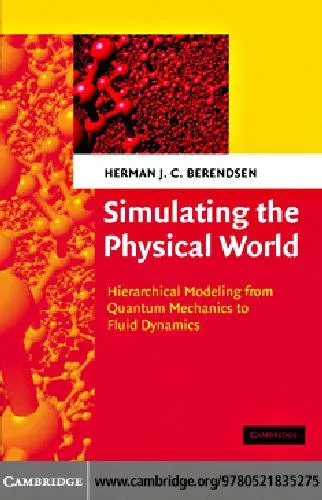
Simulating the physical world: Hierarchical modeling from quantum mechanics to fluid dynamics
Herman J. C. Berendsen
2007
View book
Book guide and evaluation
Daniel Bes
0 reviews
Published
pages
views
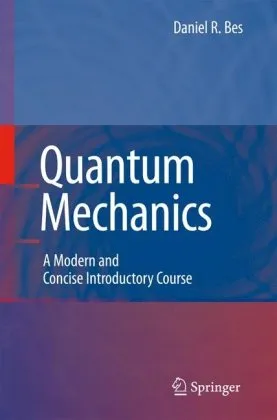
Introduction Quantum mechanics stands as one of the most revolutionary scientific theories of the 20th century, offering an elegant yet challenging view of nature at its most fundamental level. "Quantum Mechanics: A Modern and Concise Introductory Course" emerges as a comprehe
Before you read
Quantum mechanics stands as one of the most revolutionary scientific theories of the 20th century, offering an elegant yet challenging view of nature at its most fundamental level. "Quantum Mechanics: A Modern and Concise Introductory Course" emerges as a comprehensive resource, catering to students, educators, and enthusiasts seeking to delve into this intriguing field.
This book aims to introduce quantum mechanics in a clear and approachable manner. The content is structured to provide a balance between theory and practical applications, making it accessible to beginners without losing depth. The author, Daniel Bes, has crafted an educational journey that starts with fundamental principles such as wave-particle duality and progresses through topics like quantum entanglement and potential quantum computing applications.
Each chapter introduces new concepts in a logical order, supported by mathematical descriptions. Readers will find discussions on the Schrödinger equation, the uncertainty principle, and perturbation theory, among other pivotal topics. The content is interspersed with thought experiments and problem-solving sessions that solidify learning and encourage analytical thinking. Additionally, several appendices are included, providing supplementary material that explains more advanced concepts.
Through this book, readers will gain:
"Quantum mechanics does not deny reality; it broadens our understanding of it, often revealing it to be much stranger than we could have imagined."
"In the domain of the very small, the predictable certainties of classical physics dissolve into the probabilistic symphony of the quantum world."
Quantum mechanics is integral to modern physics and has paved the way for numerous innovations, from quantum computing to semiconductor technology. This book stands out by distilling complex ideas into an easily digestible format, bridging the gap between introductory textbooks and specialized papers. Its modern approach ensures that it remains relevant to the evolving landscape of quantum research.
The concise nature of Daniel Bes's writing makes it a favorite among educators who value clarity and engagement in teaching. It enables readers to build a strong foundational knowledge, encouraging them to embark on further study and make contributions to the field. As scientific exploration pushes the boundaries of the known universe, understanding the principles laid out in this book becomes increasingly important.
Your question is answered in the context of this title and author. Each answer uses 2 points.
0 reviews, 4.5 average out of 5
Sign in to publish a review.
Ask a focused question and learn from the community.
Related references that continue this learning path.
Herman J. C. Berendsen
Richard P. Feynman,Robert B. Leighton,Matthew Sands