

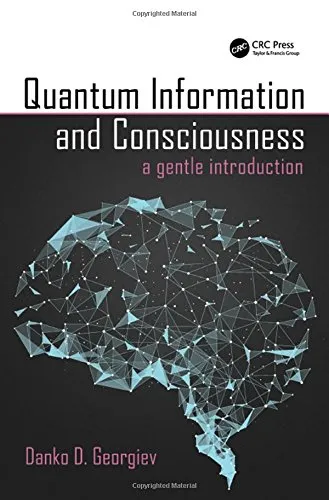
Book guide and evaluation
Quantum Information and Consciousness: A Gentle Introduction
Danko D. Georgiev
English
Beginner
Physics
4.3 / 5
0 reviews
2018
Published
363
pages
263
views
Introduction to "Quantum Information and Consciousness: A Gentle Introduction" "Quantum Information and Consciousness: A Gentle Introduction" is an innovative and thought-provoking book that bridges two of the most fascinating domains of human knowledge: quantum mechanics
Before you read
What will you get from this book?
Introduction to "Quantum Information and Consciousness: A Gentle Introduction"
"Quantum Information and Consciousness: A Gentle Introduction" is an innovative and thought-provoking book that bridges two of the most fascinating domains of human knowledge: quantum mechanics and the science of consciousness. Written by Danko D. Georgiev, this book delves deep into the intricate interplay between quantum processes and the enigmatic phenomenon of conscious awareness. Its accessible yet insightful narrative is designed to guide readers—whether they are scientists, philosophers, or curious enthusiasts—through the complex but captivating realm of quantum information theory and its implications for understanding the mind.
The book is not only a profound exploration of scientific concepts but also a philosophical reflection on the mechanisms underlying our subjective experience. Through its chapters, readers will embark on a unique journey that combines rigorous science with gentle explanations, making even complicated theories relatively easy to grasp for the uninitiated. Let us take a closer look at what the book offers and why it is such a valuable contribution to contemporary discussions on consciousness.
Detailed Summary of the Book
At its core, "Quantum Information and Consciousness: A Gentle Introduction" explores the revolutionary idea that consciousness may be deeply rooted in quantum phenomena. The book begins by introducing the foundational principles of quantum mechanics, such as superposition, entanglement, and the measurement problem, in a manner that is accessible without requiring advanced mathematical expertise. Following this foundation, Georgiev skillfully connects these principles to the concept of quantum information, which involves encoding, transmitting, and processing information at the quantum level.
Building upon this basis, the book investigates how quantum information may play a critical role in the brain's functioning and the emergence of subjective awareness. Georgiev carefully navigates through various interpretations of quantum mechanics, philosophical frameworks for consciousness, and experimental data that suggest quantum processes might underlie neural computation. Special emphasis is given to quantum models of consciousness, including the quantum brain hypothesis and the concept of quantum cognition.
The later sections of the book discuss some bold questions that have puzzled both scientists and philosophers for centuries: Is consciousness reducible to classical physics, or does it demand a quantum explanation? Can quantum entanglement account for the unity of subjective experience? And how might quantum information theory advance our understanding of free will and personal identity? By addressing these questions, Georgiev not only stimulates intellectual curiosity but also challenges readers to think profoundly about the nature of reality and our place within it.
Key Takeaways
- Quantum mechanics introduces new ways of thinking about the universe, including the role of the observer in shaping reality.
- Quantum information theory might hold the key to understanding the mind-brain relationship and subjective consciousness.
- Traditional models of consciousness rooted exclusively in classical physics may be inadequate to explain phenomena such as the unity of experience and free will.
- The interplay between quantum physics and consciousness opens up exciting new avenues for interdisciplinary research and technology.
- This book allows readers to gain a practical understanding of complex scientific theories without requiring a deep technical background.
Famous Quotes from the Book
"Quantum mechanics teaches us that reality is probabilistic, not deterministic, and that our conscious observations play a decisive role in manifesting outcomes."
"The mystery of consciousness is not merely a scientific question; it is the essence of our human existence."
"If the brain truly operates at the quantum level, then perhaps consciousness is more profoundly connected to the universe than we ever imagined."
Why This Book Matters
The study of consciousness has long been regarded as one of the last great frontiers of science, and "Quantum Information and Consciousness: A Gentle Introduction" makes a fundamental contribution to this endeavor by proposing a novel and interdisciplinary perspective. The book takes readers beyond the limitations of classical physics, opening their minds to the possibility that quantum phenomena might bridge the gap between the material brain and the immaterial mind. In a world increasingly shaped by technological and scientific advancements, this work also invites readers to reflect on the ethical, philosophical, and existential aspects of what it means to be conscious.
Furthermore, Georgiev’s ability to distill complex ideas into an engaging and comprehensible language ensures that this book is not just for quantum physicists or neuroscientists but for anyone intrigued by the mysteries of existence. By fostering dialogue between disciplines such as physics, neuroscience, psychology, and philosophy, the book lays the groundwork for groundbreaking discoveries that may one day unlock the full potential of human consciousness.
Ask this book
Your question is answered in the context of this title and author. Each answer uses 2 points.
Sign in to ask the book assistant.
Reader reviews
0 reviews, 4.3 average out of 5
No reviews yet
If you have read this book, help the next reader with your experience.
Write a review
Sign in to publish a review.
Reader questions and answers
Ask a focused question and learn from the community.
Sign in to ask or answer a question.
No questions yet
Be the first to ask a clear, useful question.
What to read next
Related references that continue this learning path.


Modern Computer Vision with PyTorch: A Practical Roadmap From Deep Learning Fundamentals to Advanced Applications and Generative AI, 2nd Edition
V Kishore Ayyadevara,Yeshwanth Reddy
2023
View book