
Book guide and evaluation
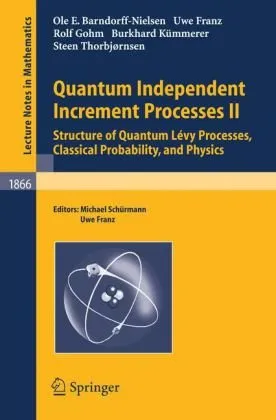
Quantum Independent Increment Processes II: Structure of Quantum Levy Processes, Classical Probability, and Physics
Uwe Franz,Rolf Rolf (auth.),Michael Schüermann,Uwe Franz (eds.)
English
Beginner
Mathematics
4.5 / 5
0 reviews
2006
Published
353
pages
174
views
Introduction to Quantum Independent Increment Processes II "Quantum Independent Increment Processes II: Structure of Quantum Lévy Processes, Classical Probability, and Physics" is an intellectually rigorous exploration of a groundbreaking area in mathematics and ph
Before you read
What will you get from this book?
Introduction to Quantum Independent Increment Processes II
"Quantum Independent Increment Processes II: Structure of Quantum Lévy Processes, Classical Probability, and Physics" is an intellectually rigorous exploration of a groundbreaking area in mathematics and physics. Authored collaboratively by Uwe Franz, Rolf Rolf, and edited by Michael Schüermann and Uwe Franz, this book builds upon the foundations of quantum probability theory, weaving together concepts from quantum mechanics, stochastic processes, and classical probability. It serves as the second installment in a series, continuing the work laid out in the first volume, thereby enriching the reader's understanding of quantum incremental processes within sophisticated mathematical frameworks.
This book is designed for both seasoned experts and motivated learners interested in delving deep into quantum probability, linking together its abstract mathematical formulations and its practical implications. By focussing on the structure of quantum Lévy processes, this comprehensive volume not only advances theoretical understanding but also lays the groundwork for various applications in modern physics, particularly in areas like quantum computing and quantum information theory.
Detailed Summary of the Book
The book systematically unpacks quantum independent increment processes, which generalize classical stochastic processes. It begins with a thorough discourse on the concepts of independent increments, stochastic integration, and their quantum extensions. Emphasis is placed on the mathematical structure of quantum Lévy processes—probability distributions supported within the quantum world, where phenomena deviate significantly from classical analogs.
Subsequent chapters analyze the interplay between classical and quantum processes, highlighting intricate relationships and distinctions that define these realms. The book delves into the role of quantum dynamic semigroups and dilation theory, presenting an invaluable toolkit for researchers who work on operator algebras and quantum fields.
A significant portion of the book addresses applications of quantum Lévy processes in physics. Their relevance to quantum Markov processes, quantum noise, and principles of quantum Brownian motion are elucidated with mathematical precision. By bridging theoretical aspects with physical interpretations, the authors ensure relevance for physicists working on emerging technologies like quantum simulations and quantum cryptography.
Finally, the book ventures into classical probability and its surprising connections to the quantum domain. Approachable to some degree for mathematicians familiar with classical stochastic calculus, this ensures accessibility across disciplines, enriching both classical and quantum fields of study.
Key Takeaways
- A precise understanding of quantum Lévy processes and their distinct properties.
- Applications of quantum stochastic processes in quantum mechanics and quantum computing.
- Insights into the relationship between classical probability and quantum probability.
- Advanced mathematical tools for analyzing quantum stochastic systems.
- Practical implications in modern physics and beyond, including quantum fields and operator algebras.
Famous Quotes from the Book
"The interplay between the quantum and the classical is not merely a theoretical endeavor; it is the very texture of reality, as understood through the lens of probability."
"The formulation of Lévy processes in the quantum domain challenges not only mathematical intuition but also our philosophical grasp of randomness in the microscopic realm."
"Physics, at its heart, strives to make the abstract concrete. Through quantum stochastic models, this marriage is no longer a dream but a functional framework."
Why This Book Matters
This book is a cornerstone contribution to the growing fields of quantum probability and quantum stochastic processes. It provides a rigorous mathematical framework that connects quantum mechanics, which governs the smallest scales of the universe, to classical probability, which dominates larger systems in our everyday world. The careful exposition of quantum Lévy processes presented here is of immense value to researchers tackling cutting-edge problems in quantum technologies and quantum thermodynamics.
In an era where quantum computers and quantum information theory are pushing the frontiers of technology, the theoretical insights encapsulated in this volume have practical ramifications. By elucidating how randomness operates in quantum systems, the book raises new questions and provides directions for exploring solutions in areas like quantum machine learning, quantum cryptography, and quantum biology.
Moreover, the authors' ability to connect complex mathematics with tangible applications bridges gaps between fields that often remain siloed. This makes the text not only an academic achievement but also a pivotal tool in the hands of interdisciplinary researchers seeking to expand their grasp of quantum theory.
Ask this book
Your question is answered in the context of this title and author. Each answer uses 2 points.
Sign in to ask the book assistant.
Reader reviews
0 reviews, 4.5 average out of 5
No reviews yet
If you have read this book, help the next reader with your experience.
Write a review
Sign in to publish a review.
Reader questions and answers
Ask a focused question and learn from the community.
Sign in to ask or answer a question.
No questions yet
Be the first to ask a clear, useful question.
What to read next
Related references that continue this learning path.

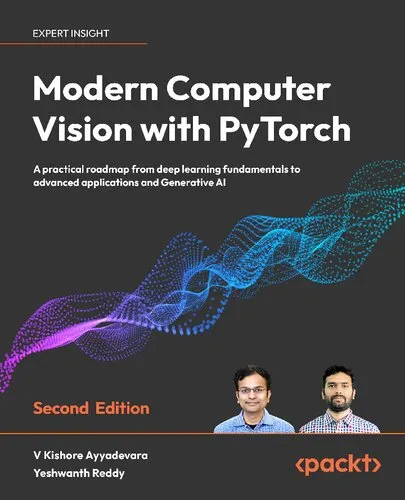
Modern Computer Vision with PyTorch: A Practical Roadmap From Deep Learning Fundamentals to Advanced Applications and Generative AI, 2nd Edition
V Kishore Ayyadevara,Yeshwanth Reddy
2023
View book