Lectures on Quantum Mechanics: With Problems, Exercises and their Solutions
Jean-Louis Basdevant
2016
View book
Book guide and evaluation
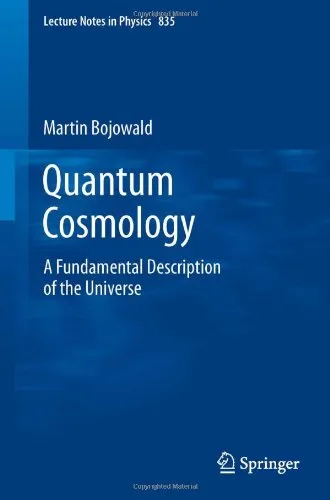
Martin Bojowald (auth.)
0 reviews
Published
pages
views
Introduction Welcome to the universe of quantum cosmology, where the mysteries of the cosmos are explored through the lens of quantum physics. Quantum Cosmology: A Fundamental Description of the Universe is an exploration into the profound questions that emerge at
Before you read
Welcome to the universe of quantum cosmology, where the mysteries of the cosmos are explored through the lens of quantum physics. Quantum Cosmology: A Fundamental Description of the Universe is an exploration into the profound questions that emerge at the intersection of quantum mechanics and cosmology. This book, designed for both curious minds and scientific professionals, serves as a vital contribution to modern scientific literature. This introduction aims to guide you through the core themes of the book while highlighting key concepts and the importance of understanding the universe at its most fundamental level.
In classical cosmology, the universe’s beginnings, evolution, and fundamental laws are studied using the framework of general relativity. Quantum cosmology, however, delves deeper. It applies quantum mechanics, the principles governing subatomic particles, to the grand scales of the universe. This synergy of quantum physics and cosmology gives rise to insightful ideas about how the universe began, its current state, and where it is heading.
This book is a rich amalgamation of theoretical physics, mathematical rigor, and philosophical inquiry. It invites readers to challenge preconceived notions and develop a deeper appreciation for the universe and its intricate symphony of laws. From exploring the origins of time and space to unraveling the mysteries of the Big Bang, Quantum Cosmology offers a comprehensive perspective on some of the most fascinating phenomena.
The book begins by setting the stage with a thorough examination of classical cosmological models and their limitations in describing the early universe and the singularities predicted by general relativity. It then transitions into quantum mechanics and how its principles can be extended into the cosmological domain.
Key topics include quantum states of the universe, the Wheeler-DeWitt equation, and the concept of wavefunctions applied to spacetime. Readers are guided through the mathematical formulations and their physical interpretations, allowing them to grasp how the universe might behave when quantum effects dominate.
The book also delves into the philosophical implications of quantum cosmology. By addressing questions such as "What does the quantum nature of time mean for the universe?" and "What role does the observer play in a quantum universe?", it ventures into topics that challenge our understanding of reality itself.
Finally, the book examines experimental possibilities and observational implications, linking theoretical predictions to the data gathered from modern cosmological research. Whether analyzing the cosmic microwave background or gravitational waves, the book ensures a connection to empirical science while remaining rooted in theoretical elegance.
"The universe is quantum at heart; to understand its origin and evolution, one cannot ignore the principles of quantum mechanics."
"Space and time, which form the fabric of our existence, are not immutable but emerge from the quantum fluctuations of reality."
"Quantum cosmology compels us to ask not where the universe came from, but how it came to be."
Quantum Cosmology: A Fundamental Description of the Universe is more than just a scientific text; it is an invitation to explore the depths of our existence. By connecting quantum mechanics, cosmology, and philosophical thinking, the book serves as a bridge between the empirical and the abstract. It educates readers on the theoretical underpinnings of the universe while encouraging them to question what they know about reality.
This book is vital for modern physics because it addresses complexities where traditional theories break down—such as singularities and the earliest moments of the cosmos. Moreover, its insights have implications beyond physics, influencing discussions in philosophy, theology, and metaphysics. Whether you are a student, researcher, or intellectually curious reader, this book provides a deeper understanding of our universe and our place within it.
By reading this book, you're not only engaging with the cutting edge of theoretical physics, but also contributing to humanity's collective search for knowledge about our ultimate origins.
Your question is answered in the context of this title and author. Each answer uses 2 points.
0 reviews, 4.4 average out of 5
Sign in to publish a review.
Ask a focused question and learn from the community.
Related references that continue this learning path.
Jean-Louis Basdevant
Arnold F. Nikiforov,Vladimir G. Novikov,V.B. Uvarov (auth.)