Book guide and evaluation
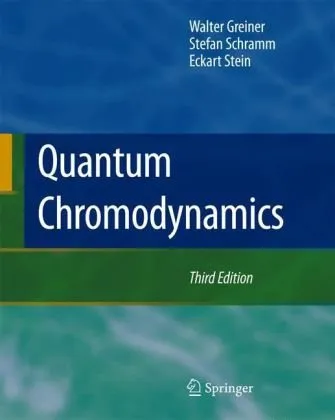
Quantum Chromodynamics
Walter Greiner,Stefan Schramm,Eckart Stein,D.A. Bromley
English
Beginner
Quantum
4.9 / 5
0 reviews
2007
Published
562
pages
549
views
Introduction to "Quantum Chromodynamics" Welcome to "Quantum Chromodynamics," a fascinating exploration of one of the most profound and intricate areas of modern physics: the theory of the strong nuclear force. Written by Walter Greiner, Stefan Schramm, Eckart Stei
Before you read
What will you get from this book?
Introduction to "Quantum Chromodynamics"
Welcome to "Quantum Chromodynamics," a fascinating exploration of one of the most profound and intricate areas of modern physics: the theory of the strong nuclear force. Written by Walter Greiner, Stefan Schramm, Eckart Stein, and featuring insights from D.A. Bromley, this book serves as a cornerstone reference for students, researchers, and enthusiasts of quantum field theory. Quantum Chromodynamics (QCD) is the science that unravels the mysteries of how quarks and gluons—the fundamental building blocks of nucleons—interact.
With a robust foundation in quantum theory and particle physics, the authors delve deeply into the mathematical framework and experimental confirmations of QCD. This book presents complex topics with clarity, precision, and an emphasis on physical interpretation. Whether you're a seasoned physicist or just beginning to explore the fascinating world of theoretical physics, this work serves as an indispensable guide to understanding the mechanics of the universe at its most fundamental level. Let us walk you through some key highlights of what this book has to offer.
Detailed Summary of the Book
"Quantum Chromodynamics" begins by outlining the historical development of the strong nuclear force, tracing the path from the discovery of nucleons to the formulation of QCD. Early sections provide an introduction to the Standard Model of particle physics, emphasizing its successes and the role of QCD as its cornerstone theory for the strong interaction. The book systematically covers the theoretical framework of QCD, introducing important concepts such as color charge, asymptotic freedom, and confinement.
In later chapters, readers are guided through advanced topics, including perturbative QCD, non-perturbative techniques, and the computation of observable quantities in high-energy experiments. The narrative also delves into cutting-edge research, covering areas like quark-gluon plasma, lattice QCD, and the behavior of hadrons under extreme conditions. Each chapter builds upon the last, steadily increasing in mathematical rigor and complexity, yet remaining accessible through carefully crafted explanations and examples.
Throughout the text, experimental evidence supporting theoretical predictions is thoroughly discussed. This ensures that readers appreciate how QCD has evolved from a theoretical proposition to an experimentally verified theory that governs high-energy particle interactions, such as those seen in particle accelerators like the Large Hadron Collider (LHC).
Key Takeaways
- The fundamental principles of Quantum Chromodynamics and how it shapes our understanding of the universe.
- The significance of asymptotic freedom, explaining why quarks behave differently at high and low energies.
- The remarkable phenomenon of color confinement, where quarks cannot exist freely in nature.
- Insights into the experimental techniques that validate QCD, including collider physics and lattice QCD simulations.
- A glimpse into the frontiers of strong interaction research, including the study of quark-gluon plasma and hadronization processes.
Famous Quotes from the Book
"Quantum Chromodynamics teaches us that the most fundamental forces in the universe can exhibit both the utmost simplicity and unimaginable complexity when viewed through the lens of human curiosity."
"The challenge of understanding QCD lies not only in its mathematics but in its seamless merging of theory with experiment, which continuously pushes the boundaries of human knowledge."
Why This Book Matters
In modern physics, few theories can claim the elegance and universal applicability of Quantum Chromodynamics. This book holds immense importance not only as a resource for aspiring physicists but also as a testament to the collaborative effort of scientists over decades to understand the nature of the strong interaction. Through rigorous theoretical discussions and numerous examples, this book inspires readers to appreciate the intricate and oftentimes awe-inspiring beauty of the quantum world.
As the cornerstone of the Standard Model, QCD sheds light on the very building blocks of matter and the forces that govern their interactions. This book is a critical resource for understanding phenomena ranging from the internal structures of protons and neutrons to large-scale cosmic processes such as supernovae and neutron star collisions. In essence, "Quantum Chromodynamics" is a narrative of human curiosity and unrelenting pursuit of knowledge—a story that every physicist and science enthusiast should familiarize themselves with.
Ask this book
Your question is answered in the context of this title and author. Each answer uses 2 points.
Sign in to ask the book assistant.
Reader reviews
0 reviews, 4.9 average out of 5
No reviews yet
If you have read this book, help the next reader with your experience.
Write a review
Sign in to publish a review.
Reader questions and answers
Ask a focused question and learn from the community.
Sign in to ask or answer a question.
No questions yet
Be the first to ask a clear, useful question.
What to read next
Related references that continue this learning path.
Lectures on Quantum Mechanics: With Problems, Exercises and their Solutions
Jean-Louis Basdevant
2016
View book

Quantum-Statistical Models of Hot Dense Matter: Methods for Computation Opacity and Equation of State
Arnold F. Nikiforov,Vladimir G. Novikov,V.B. Uvarov (auth.)
2005
View book