

Book guide and evaluation
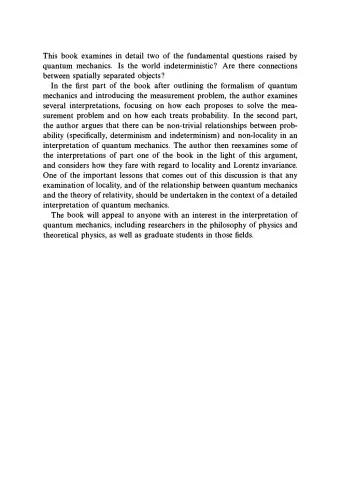
Quantum Chance and Non-locality: Probability and Non-locality in the Interpretations of Quantum Mechanics
W. Michael Dickson
English
Beginner
Art
3.9 / 5
0 reviews
1998
Published
264
pages
252
views
Introduction to "Quantum Chance and Non-locality: Probability and Non-locality in the Interpretations of Quantum Mechanics" "Quantum Chance and Non-locality" explores one of the most fascinating and intellectually challenging aspects of modern physics: the enigmati
Before you read
What will you get from this book?
Introduction to "Quantum Chance and Non-locality: Probability and Non-locality in the Interpretations of Quantum Mechanics"
"Quantum Chance and Non-locality" explores one of the most fascinating and intellectually challenging aspects of modern physics: the enigmatic nature of quantum mechanics. This book ventures into the heart of quantum theory, dissecting its interpretations, the role of probability, and, significantly, the concept of non-locality—how particles seem to communicate instantaneously across vast distances. By combining mathematical rigor with a philosophical perspective, this work addresses profound questions about the universe, reality, and the limits of human understanding. It provides an accessible yet comprehensive treatment suitable for physicists, philosophers, and intellectually curious readers alike.
Detailed Summary of the Book
"Quantum Chance and Non-locality" begins by introducing the foundational concepts of quantum mechanics, offering a succinct summary of its historical development. From the discovery of wave-particle duality to Schrödinger’s equation and the uncertainties of Heisenberg’s principle, the book builds a coherent narrative that guides readers into the more intricate topics of quantum phenomena.
Central to the discussions is the contentious and counterintuitive concept of non-locality—an idea brought into mainstream quantum theory through Bell’s Theorem. This theorem decisively demonstrated that quantum mechanics is inherently non-local if we assume the reality of certain hidden variables. The book unpacks Bell's Theorem in detail, alongside other key experiments such as those by Aspect and Zeilinger, which provide strong empirical support for our modern understanding of quantum entanglement.
Probability occupies another crucial role in the text. In quantum mechanics, probabilities do not merely represent ignorance, as in classical mechanics. Instead, they are fundamental to the theory itself. Through an analysis of the Copenhagen interpretation, Everett's "many worlds" interpretation, and Bohmian mechanics, the book examines how probability influences our understanding of reality and measurements.
The book concludes by highlighting the importance of philosophical inquiry in physics. It encourages readers to not only accept quantum mechanics as a predictive tool but to grapple with its deeper implications for metaphysics, epistemology, and even human free will.
Key Takeaways
- The concept of non-locality is a cornerstone of quantum mechanics, fundamentally challenging our classical notions of space and causality.
- Probability in quantum mechanics is intrinsic and differs from classical probability, presenting a novel way of thinking about reality.
- Interpretations such as the Copenhagen interpretation, many-worlds, and Bohmian mechanics each tell a distinct story about the nature of quantum reality, yet none is definitive.
- Philosophy is indispensable when interpreting quantum mechanics, as the theory raises questions that transcend the boundaries of pure physics.
- Experiments such as those testing Bell’s Theorem demonstrate the interplay between theoretical implications and empirically verifiable phenomena.
Famous Quotes From the Book
Here are some thought-provoking quotes from the book that capture its essence:
"Quantum mechanics does more than describe reality; it forces us to reconsider what we mean by 'reality' itself."
"Non-locality is not a flaw in quantum mechanics—it is a feature that compels us to recognize the profound connectedness of the universe."
"Probability in quantum mechanics is not the shadow of our ignorance but a guide to the structure of the physical world."
Why This Book Matters
The relevance of "Quantum Chance and Non-locality" lies in its ability to bridge the theoretical and philosophical aspects of quantum mechanics. In a world where quantum technologies such as quantum computing and cryptography are rapidly advancing, understanding the foundational principles of the theory has never been more important. This book provides the tools to delve beyond the equations, into the metaphysical questions that quantum mechanics raises.
Whether you are a seasoned physicist seeking clarity on interpretations of quantum mechanics or a newcomer curious about the mysteries of the universe, this book offers valuable insights. It challenges its readers to think deeply about the kind of reality we inhabit and the tools we use to describe it, making it a cornerstone work in the fields of both physics and philosophy.
Ask this book
Your question is answered in the context of this title and author. Each answer uses 2 points.
Sign in to ask the book assistant.
Reader reviews
0 reviews, 3.9 average out of 5
No reviews yet
If you have read this book, help the next reader with your experience.
Write a review
Sign in to publish a review.
Reader questions and answers
Ask a focused question and learn from the community.
Sign in to ask or answer a question.
No questions yet
Be the first to ask a clear, useful question.
What to read next
Related references that continue this learning path.


Modern Computer Vision with PyTorch: A Practical Roadmap From Deep Learning Fundamentals to Advanced Applications and Generative AI, 2nd Edition
V Kishore Ayyadevara,Yeshwanth Reddy
2023
View book