
Book guide and evaluation
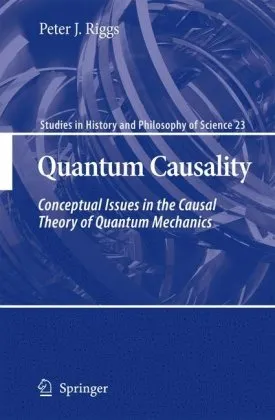
Quantum Causality: Conceptual Issues in the Causal Theory of Quantum Mechanics
Peter J. Riggs (auth.)
English
Beginner
Physics
4.5 / 5
0 reviews
2009
Published
238
pages
514
views
Introduction to "Quantum Causality: Conceptual Issues in the Causal Theory of Quantum Mechanics" In Quantum Causality, Peter J. Riggs delves deep into one of the most intriguing and philosophically challenging topics in modern physics: causality within the framework of qua
Before you read
What will you get from this book?
Introduction to "Quantum Causality: Conceptual Issues in the Causal Theory of Quantum Mechanics"
In Quantum Causality, Peter J. Riggs delves deep into one of the most intriguing and philosophically challenging topics in modern physics: causality within the framework of quantum mechanics. While quantum theory has revolutionized our understanding of the physical world at microscopic scales, its philosophical interpretation has sparked significant debate, particularly concerning how causal relationships manifest in quantum systems. This book addresses these debates and introduces readers to the causal theory of quantum mechanics, a conceptual framework designed to reconcile causality with quantum phenomena.
The book examines the fundamental philosophical underpinnings of causality and juxtaposes them with developments in quantum mechanics. Written in a clear and rigorous manner, it aims to bridge the gap between physicists and philosophers, offering a systematic exploration of causality's place in quantum mechanics. Relevant to both theoretical physicists and scholars in the humanities, this text provides an intellectual foundation for understanding the intersection of causation and the peculiarities of the quantum world.
Detailed Summary of the Book
Riggs provides a comprehensive overview of causality, tracing its roots within classical physics and examining its transformation in the quantum domain. He explores whether the notion of cause-and-effect relationships—foundational to classical physics—can be preserved in quantum contexts or whether quantum theory demands an entirely new interpretation of causality.
The book introduces the causal theory of quantum mechanics, an alternative interpretation that seeks to embed causality within quantum processes without disregarding empirical observations and experimental results. Through rigorous philosophical analysis, Riggs addresses common objections to causality in quantum systems, such as the phenomenon of quantum entanglement and the apparent violation of "locality." He carefully analyzes whether concepts like determinism, agency, and causation retain their relevance when applied to quantum processes.
Alongside providing theoretical insights, Riggs discusses practical implications of the causal theory for emerging quantum technologies, such as quantum computing. By reexamining causality's role in quantum systems, he sheds light on unresolved issues and proposes pathways for further research.
Key Takeaways
- The concept of causality is essential yet contentious within quantum mechanics, prompting diverse interpretations across physics and philosophy.
- The causal theory of quantum mechanics provides a structured framework that preserves causation without contradicting quantum phenomena.
- Quantum phenomena, such as entanglement and wave-function collapse, challenge classical notions of locality and causation but are not entirely inconsistent with a causal interpretation.
- Philosophical discussions about quantum causality have direct implications for the development of quantum technologies and theories of the universe.
- Riggs emphasizes the need to reconcile philosophical consistency with empirical adequacy in theoretical physics.
Famous Quotes from the Book
"Causality remains a cornerstone of scientific inquiry, yet the quantum realm challenges us to reconsider its very definition."
"To engage seriously with quantum mechanics is to confront philosophical questions, not merely mathematical formalisms."
"A theory must do more than predict phenomena; it must also strive to make conceptual sense of the world it describes."
Why This Book Matters
Understanding quantum causality is not merely an academic exercise; it has profound implications for physics, philosophy, and beyond. As quantum theories underpin emerging technologies, such as quantum computing and quantum cryptography, conceptual clarity about causality becomes increasingly critical. Moreover, the philosophical questions raised by quantum causality challenge us to rethink the nature of reality and our place in it.
Riggs' Quantum Causality stands out for its methodical approach, balancing technical precision with intellectual accessibility. It not only appeals to physicists striving to interpret quantum phenomena but also to philosophers interested in the science of causation. By addressing both audiences, this book contributes to ongoing debates about determinism, agency, and the nature of reality in one of the most mysterious areas of scientific inquiry.
By presenting the causal theory of quantum mechanics, Riggs challenges readers to reconsider long-held assumptions. The book serves as a call to think deeply about how we conceptualize causation in light of quantum insights, making it a must-read for anyone interested in the intersection of physics and philosophy.
Ask this book
Your question is answered in the context of this title and author. Each answer uses 2 points.
Sign in to ask the book assistant.
Reader reviews
0 reviews, 4.5 average out of 5
No reviews yet
If you have read this book, help the next reader with your experience.
Write a review
Sign in to publish a review.
Reader questions and answers
Ask a focused question and learn from the community.
Sign in to ask or answer a question.
No questions yet
Be the first to ask a clear, useful question.
What to read next
Related references that continue this learning path.


Modern Computer Vision with PyTorch: A Practical Roadmap From Deep Learning Fundamentals to Advanced Applications and Generative AI, 2nd Edition
V Kishore Ayyadevara,Yeshwanth Reddy
2023
View book