
Harsh Rajput
2025/09/08
5 / 5
This book is all you need to learn about equity portfolio management.
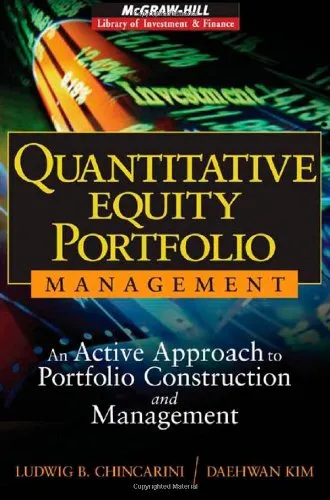
Book guide and evaluation
Ludwig B Chincarini,Daehwan Kim
1 reviews
Published
pages
views
Welcome to an in-depth exploration of Quantitative Equity Portfolio Management, a seminal work in the vast landscape of investment and finance. Written by seasoned experts Ludwig B Chincarini and Daehwan Kim, this book serves as an essential guide for anyone looking to delve
Before you read
Welcome to an in-depth exploration of Quantitative Equity Portfolio Management, a seminal work in the vast landscape of investment and finance. Written by seasoned experts Ludwig B Chincarini and Daehwan Kim, this book serves as an essential guide for anyone looking to delve into the complexities of quantitative approaches to equity portfolio management. Whether you're a budding investor or a seasoned portfolio manager, this book provides the tools, techniques, and insights necessary for a comprehensive understanding of active portfolio management through quantitative methods.
Quantitative Equity Portfolio Management is an extensive resource that bridges the gap between theoretical finance and practical application. It begins with an introduction to quantitative methods and statistical techniques, carefully laying the foundation needed to comprehend the more advanced concepts that follow. The book explains the principles of constructing quantitative equity portfolios, focusing on the importance of diversification, asset allocation, and risk management. A significant portion of the book is dedicated to investment strategies, including factor models, alpha signals, and the use of quantitative signals to enhance portfolio returns.
Furthermore, the authors delve into sophisticated topics such as optimization techniques, backtesting strategies, and performance evaluation metrics. Real-world examples and case studies underscore the practicality of the concepts discussed, providing readers with concrete illustrations of how these methods are applied in the finance industry.
The book offers many insights and strategies critical for quantitative investing. Here are some key takeaways:
“In the world of quantitative finance, models are not just tools—they are frameworks for understanding complex market behaviors.”
“Quantitative equity portfolio management marries the science of numbers with the art of investment judgment.”
This book is pivotal for a multitude of reasons. It offers a comprehensive guide to quantitative approaches, which are increasingly central to modern finance. In an era where data-driven decision-making is paramount, understanding and applying quantitative techniques can provide a substantial edge to investors and financial professionals.
Moreover, the book's practical approach, with its focus on real-world application, empowers its readers to directly implement the strategies discussed. This practical orientation ensures that readers are not just learning theoretical concepts but are also equipped to apply these strategies effectively within the dynamic contexts of financial markets.
Ultimately, Quantitative Equity Portfolio Management serves as a critical resource, providing the skills and insights necessary to succeed in today's data-dominated investment landscape.
Your question is answered in the context of this title and author. Each answer uses 2 points.
1 reviews, 5.0 average out of 5
2025/09/08
5 / 5
This book is all you need to learn about equity portfolio management.
Sign in to publish a review.
Ask a focused question and learn from the community.
Related references that continue this learning path.
S. R. Vishwanath (auth.),Chandrasekhar Krishnamurti,Ramanna Vishwanath (eds.)